
Pipeline Generation in 2026: How Real Conversations Now Decide Revenue
- Table of contents
January 09, 2026
| |18 min read
| |TL;DR
Pipeline generation is the end-to-end process of turning demand into qualified, revenue-ready opportunities that sales teams can realistically close. It goes beyond collecting leads and focuses on building predictable revenue, not vanity volume.
Unlike traditional lead generation, pipeline generation prioritizes intent, timing, and deal progression. The goal is not more contacts. The goal is more opportunities that actually move forward in the sales cycle.
In 2026, high-performing B2B teams build pipeline by combining AI-assisted SDR workflows, real-time intent data, content-led demand, and LinkedIn-first go-to-market motions. Automation supports the process, but real conversations are what convert interest into revenue.
This guide breaks down what pipeline generation really means today, how modern pipeline systems work, which strategies scale sustainably, where AI creates leverage, and how B2B teams grow pipeline without burning budget, trust, or sales credibility.
Why Pipeline Generation Matters More Than Ever
The Shift From Leads to Revenue Accountability
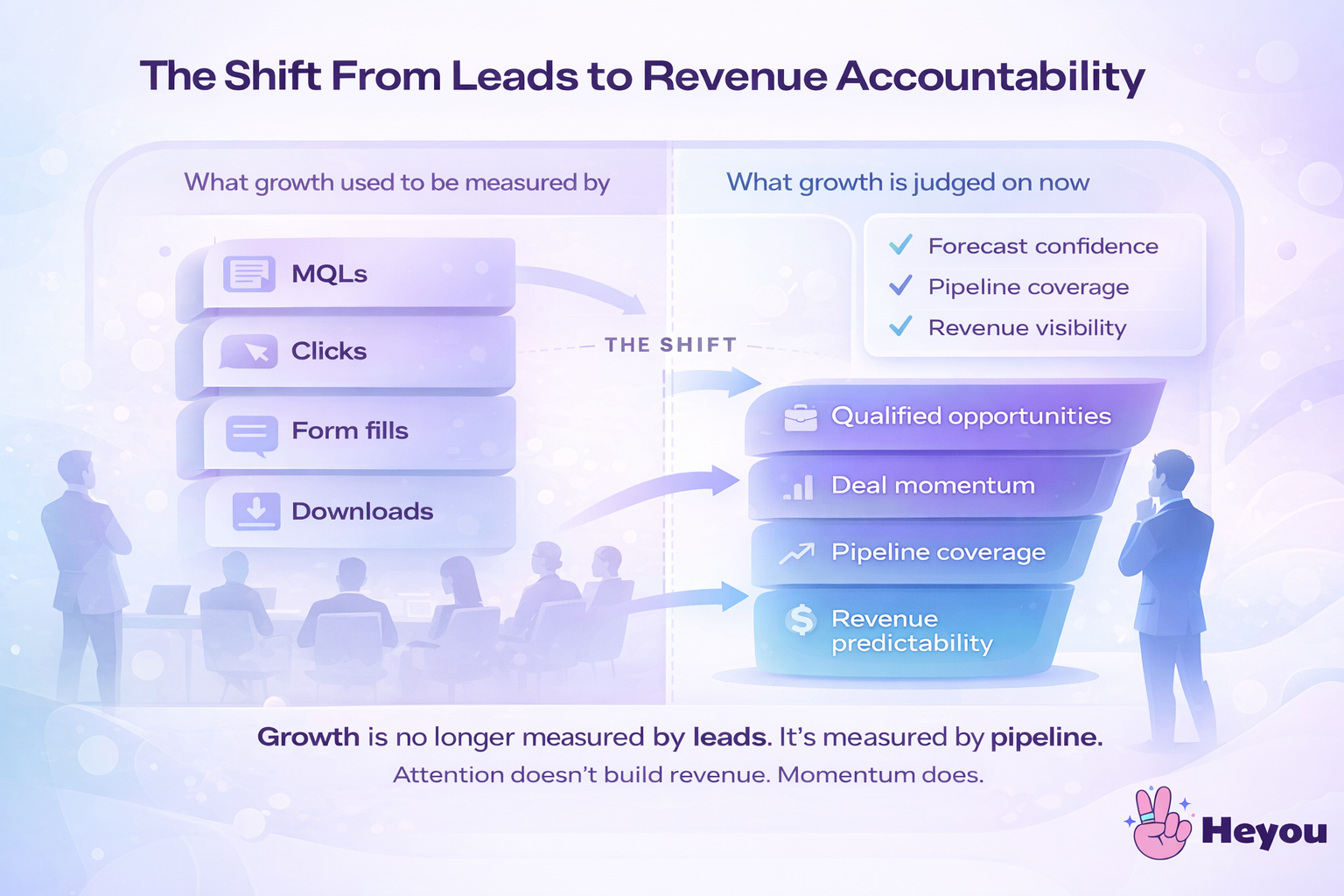
For a long time, B2B growth was measured by lead volume. Marketing teams were rewarded for MQLs, downloads, and form fills, even when those leads never translated into real sales opportunities. That model no longer holds.
Today, pipeline generation is about revenue accountability, not activity metrics. Boards and executive teams expect marketing and sales to jointly own pipeline quality, deal progression, and revenue predictability, not just top-of-funnel output.
This shift reflects a simple reality. More leads do not automatically produce more revenue. In many cases, excessive lead volume slows sales teams down, increases disqualification work, and dilutes focus away from high-intent opportunities.
Why MQL Volume No Longer Equals Growth
Marketing-qualified leads were designed to signal interest, not readiness to buy. Over time, many teams began treating MQL volume as a growth indicator, even when sales teams struggled to convert those leads into meaningful conversations.
The problem is not lead generation itself. The problem is misaligned incentives. When success is measured by volume instead of outcomes, teams optimize for quantity rather than relevance, timing, or intent.
Pipeline generation exists to close this gap. It shifts the focus from collecting contacts to creating opportunities that have a real chance of turning into revenue.
How Boards Now Measure Pipeline Coverage, Not Clicks
In 2026, executive leadership pays far less attention to clicks, impressions, or raw lead counts. What matters instead is pipeline coverage and whether the business has enough qualified opportunities to support revenue goals.
Pipeline health is evaluated through indicators such as:
- The relationship between pipeline size and revenue targets
- How consistently opportunities move from stage to stage
- How long deals take to progress through the funnel
This change reflects a broader understanding that revenue predictability comes from pipeline quality, not top-of-funnel noise.
Why Founders and CMOs Are Judged on Pipeline Predictability
For founders and CMOs, the core question has shifted. It is no longer “Are we generating enough leads?” but “Can we reliably forecast revenue?”
Investor conversations, board meetings, and strategic planning now revolve around:
- Pipeline quality and structure
- Stage-to-stage conversion consistency
- Confidence in forward-looking revenue projections
Pipeline generation sits at the center of this accountability. When pipeline is weak or inflated, forecasting breaks. When pipeline is healthy and grounded in real buyer intent, planning becomes far more reliable.
Market Forces Shaping Pipeline Generation in 2026

The Growing Role of AI in Go-to-Market Execution
AI is no longer experimental in go-to-market teams. It is widely used to support tasks such as prioritization, outreach assistance, and pipeline analysis.
At the same time, teams have learned that AI alone does not create trust. The strongest pipeline outcomes come from AI-supported, human-led engagement, where automation improves efficiency but conversations remain authentic and context-aware.
Why Volume-Based Cold Outbound Is Losing Effectiveness
Cold outbound has not disappeared, but its effectiveness has declined as buyers become more selective and more protected from generic outreach.
As inboxes and social channels become increasingly saturated, undifferentiated volume-based outreach struggles to earn attention, let alone responses. This has forced teams to rethink pipeline generation strategies that rely primarily on scale instead of relevance.
The Rise of Intent-Driven Buying Journeys
Modern buyers complete much of their evaluation independently before engaging with sales. By the time a conversation begins, expectations are higher and tolerance for irrelevant outreach is lower.
As a result, pipeline generation has become increasingly intent-driven, prioritizing:
- Behavioral signals
- Content engagement patterns
- Social interactions
- Readiness for conversation
Pipeline is no longer created at first contact. It is created when intent, timing, and trust align.
Where Heyou Fits Naturally in the Modern Pipeline
Pipeline generation breaks down when engagement feels:
- Robotic
- Spam-driven
- Disconnected from buyer context
Automation alone cannot fix this. In many cases, it amplifies the problem.
Modern pipeline generation depends on human-feeling, trust-based engagement at scale, where conversations feel relevant, timely, and personal, even when supported by AI.
This is where Heyou fits naturally into the pipeline motion. By supporting real conversations instead of scripted outreach, teams can scale engagement without sacrificing credibility, trust, or long-term revenue potential.
What Is Pipeline Generation?
Pipeline generation is not a tactic or a single channel. It is a systematic way of creating revenue opportunities that can be forecasted, managed, and scaled. While lead generation focuses on interest, pipeline generation focuses on progress. Every stage is measured by movement toward revenue, not by activity alone.
Pipeline Generation Definition
Simple definition
Pipeline generation is the process of creating qualified sales opportunities that are actively progressing toward revenue. It focuses on opportunities that have intent, context, and a realistic path to close.
In practical terms, pipeline generation answers one question:
Which opportunities are actually moving forward?
Business definition
From a business perspective, pipeline generation aligns marketing, sales, content, and technology to move buyers from initial awareness to closed-won deals in a measurable and repeatable way.
It connects:
- Demand creation
- Buyer engagement
- Qualification
- Opportunity progression
into a single, accountable revenue motion.
Pipeline Generation Meaning in Sales
For sales teams, pipeline generation is not about how much activity happens. It is about how much revenue potential exists and how likely it is to close.
Pipeline vs activity
- Activity measures effort
- Pipeline measures opportunity
Calls, emails, meetings, and messages are inputs. Pipeline is the output that matters.
Sales teams define pipeline as:
- Opportunities that meet qualification standards
- Deals that have buyer engagement and momentum
- Accounts with a clear next step
Why pipeline is about probability, not promises
Pipeline does not represent guaranteed revenue. It represents probability-weighted potential.
A healthy pipeline reflects:
- Buyer intent
- Stage progression
- Deal velocity
- Confidence in next actions
This is why strong pipeline generation focuses on signals, not assumptions.
What makes pipeline “real” versus inflated
Real pipeline:
- Is built on active buyer conversations
- Shows consistent stage movement
- Can be reviewed and defended in forecasting discussions
Inflated pipeline:
- Is filled with stalled or inactive deals
- Relies on vague follow-ups
- Exists to look healthy rather than perform well
Pipeline generation exists to eliminate this inflation and create clarity.
What Is Pipeline Generation in B2B SaaS?
Pipeline generation in B2B SaaS has distinct characteristics that make it different from transactional or high-velocity sales models.
Long buying cycles
B2B SaaS deals often take weeks or months to close. Pipeline generation must support ongoing engagement, not one-time conversion events.
Multiple stakeholders
Most B2B SaaS purchases involve several decision-makers. Effective pipeline generation accounts for:
- Different roles
- Different concerns
- Different timelines
Pipeline grows when conversations expand across the buying group.
Trust-first journeys
Buyers evaluate risk, credibility, and long-term value. Pipeline generation depends on trust earned over time, not just persuasive messaging.
Content and conversation-driven decisions
In B2B SaaS, buyers:
- Research independently
- Consume content before engaging sales
- Expect informed, relevant conversations
Pipeline generation succeeds when content builds context and conversations convert that context into revenue.
Pipeline Generation vs Lead Generation
Pipeline generation and lead generation are often used interchangeably, but they serve very different purposes. Confusing the two creates misaligned teams, inflated expectations, and unpredictable revenue.
The core difference is simple: lead generation creates interest, while pipeline generation creates revenue opportunity.
| Dimension | Lead Generation | Pipeline Generation |
|---|---|---|
| Primary goal | Capture interest | Create revenue-ready opportunities |
| Optimization focus | Volume and reach | Revenue and deal progression |
| Core output | Leads and contacts | Qualified opportunities |
| Measurement | MQLs, form fills, sign-ups | Opportunity creation, velocity, coverage |
| Sales alignment | Often indirect or delayed | Built into the process |
| Revenue accountability | Limited | Explicit and continuous |
| Risk | High volume, low intent | Fewer opportunities, higher quality |
Across B2B SaaS teams, fewer than 10% of raw leads typically convert into closed revenue, which is why pipeline generation prioritizes intent and deal progression over volume. (Source)
Lead Generation Pipeline vs Sales Pipeline
| Dimension | Lead Generation Pipeline | Sales Pipeline |
|---|---|---|
| Primary focus | Leads and contacts | Qualified opportunities |
| What it tracks | Form fills, sign-ups, engagement | Deals moving through defined stages |
| Optimization goal | Top-of-funnel activity | Revenue outcomes |
| Success signal | Volume of leads | Progression and momentum |
| Conversion accountability | Often stops at handoff to sales | Continues through the entire deal cycle |
| Qualification depth | Basic interest-based | Intent, readiness, and fit-based |
| Ownership | Primarily marketing | Shared between marketing and sales |
| Forecast reliability | Low | High |
Metrics That Matter
| Metric Type | Lead Generation | Pipeline Generation |
|---|---|---|
| Volume metrics | Lead volume | Opportunity creation rate |
| Efficiency metrics | Cost per lead | Stage-to-stage conversion |
| Outcome metrics | Conversion to MQL | Pipeline coverage and velocity |
| Revenue connection | Indirect | Direct and measurable |
Modern B2B pipeline benchmarks show that predictable revenue depends far more on conversion quality, coverage, and velocity than on lead volume alone.
Key B2B Pipeline Benchmarks (2025–2026)
| Pipeline Metric | Typical B2B Range | High-Performing Teams |
|---|---|---|
| Lead-to-Customer Conversion | 2–5% | Above 5% |
| MQL-to-SQL Conversion | 15–21% | 25%+ |
| SQL-to-Opportunity Conversion | 30–59% | 60%+ |
| Opportunity-to-Close (Win Rate) | 20–30% | 30–40% |
| Pipeline Coverage Ratio | 3x–4x revenue target | 5x+ (3–5x for enterprise) |
| Average Sales Cycle Length | ~84 days (≈3 months) | Shorter with higher velocity |
Why Most Companies Fail Here
Most companies struggle because lead generation and pipeline generation are optimized separately.
Common failure points:
- Marketing optimizes forms and volume
- Sales optimizes calls and meetings
- No shared ownership of pipeline quality
Without a shared definition of what qualifies as real pipeline, teams work toward different goals. The result is friction, wasted effort, and unreliable forecasting.
Pipeline generation succeeds only when both teams are aligned around the same revenue outcome, not isolated metrics.
The Modern Pipeline Generation Funnel (End-to-End)
Pipeline generation is no longer a straight line from awareness to close. In 2026, buyers move through the funnel in loops, not steps. They explore, disengage, return, and compare options on their own terms. The modern pipeline must support this behavior instead of forcing linear progression.
Awareness to Opportunity Is Not Linear
The traditional funnel assumes buyers move smoothly from awareness to interest to decision. In reality, modern buyers loop, pause, and self-educate long before they are ready to talk to sales.
Why buyers loop, pause, and self-educate
Buyers today:
- Research independently across multiple channels
- Delay conversations until they feel informed
- Revisit vendors only when timing and urgency align
This means pipeline is not created at first touch. It is created when context, relevance, and readiness converge.
How AI search and LinkedIn changed discovery
Discovery has shifted away from websites and forms toward:
- AI-powered search summaries
- Social feeds and professional networks
- Peer conversations and shared experiences
Buyers now encounter brands through answers and conversations, not just ads or landing pages. LinkedIn, in particular, plays a dual role as both a discovery engine and a trust-building layer, where repeated exposure and human interaction influence buying decisions.
Pipeline generation must account for these discovery paths instead of relying on a single entry point.
Core Pipeline Stages
While buyer movement is non-linear, strong pipeline generation still relies on clear stages that help teams create momentum and accountability.
Each stage feeds the next and can also loop backward when timing changes.
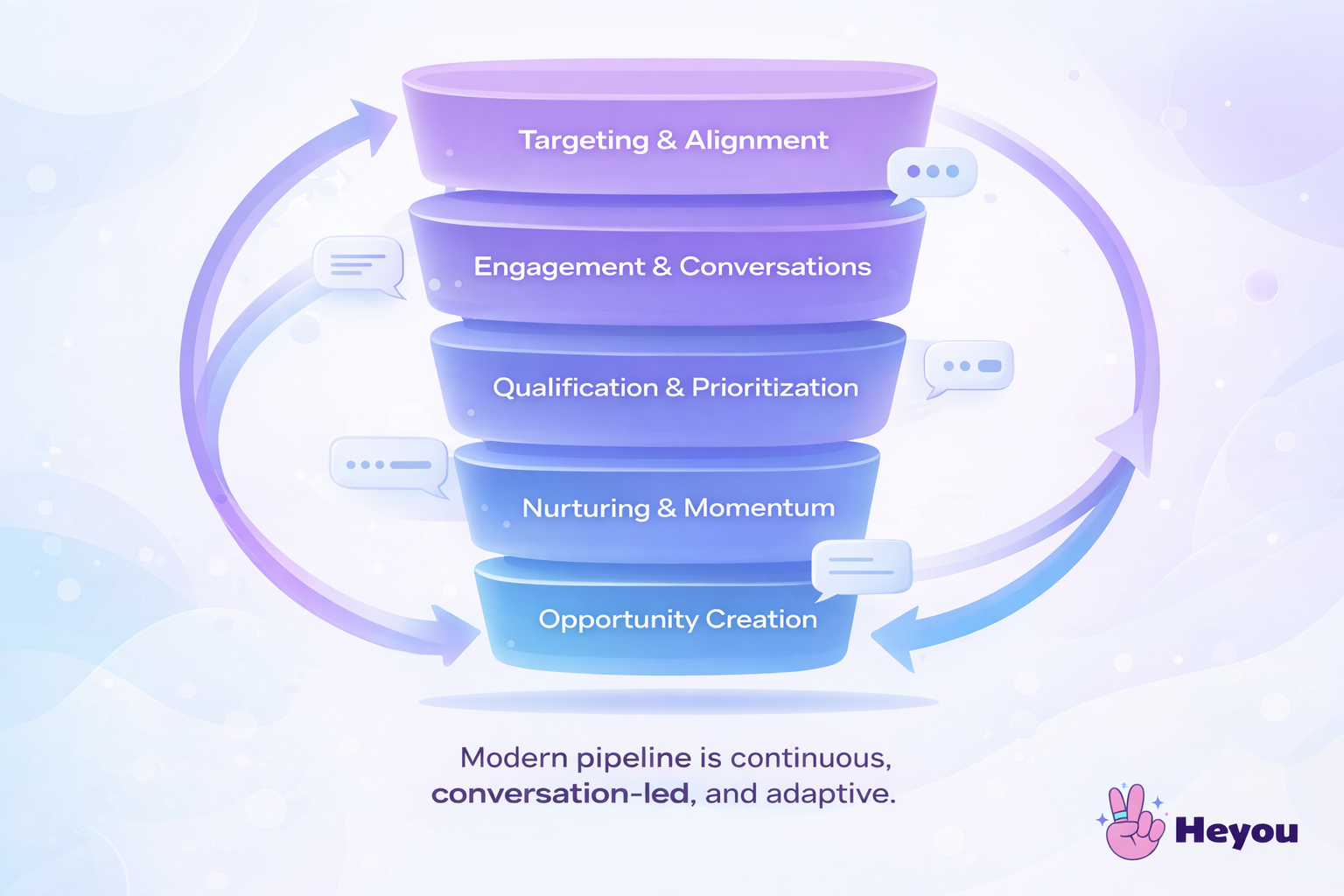
Targeting and alignment
Pipeline generation starts with who you engage and why.
This stage focuses on:
- Defining the right accounts and personas
- Aligning marketing and sales on qualification standards
- Prioritizing relevance over reach
Without strong targeting, every downstream stage becomes inefficient.
Engagement and conversations
Engagement is where pipeline begins to take shape.
This stage is about:
- Starting meaningful conversations
- Providing value before asking for commitment
- Earning responses rather than forcing them
Conversations, not impressions, signal whether an account belongs in the pipeline.
Qualification and prioritization
Not every engaged account should become an opportunity.
This stage focuses on:
- Assessing intent and readiness
- Prioritizing accounts with momentum
- De-emphasizing stalled or low-fit conversations
Effective qualification keeps the pipeline clean and realistic.
Nurturing and momentum
Many deals are not lost. They are delayed.
This stage exists to:
- Maintain relevance over time
- Re-engage when timing improves
- Build trust through continued value
Nurturing is not about reminders. It is about staying useful until the buyer is ready.
Opportunity creation
An opportunity is created when:
- There is mutual interest
- The problem is clear
- Next steps are defined
At this stage, pipeline moves from potential to actionable revenue. The opportunity is real because it is supported by context, conversation history, and buyer intent.
Pipeline Generation Strategy (Built for 2026)
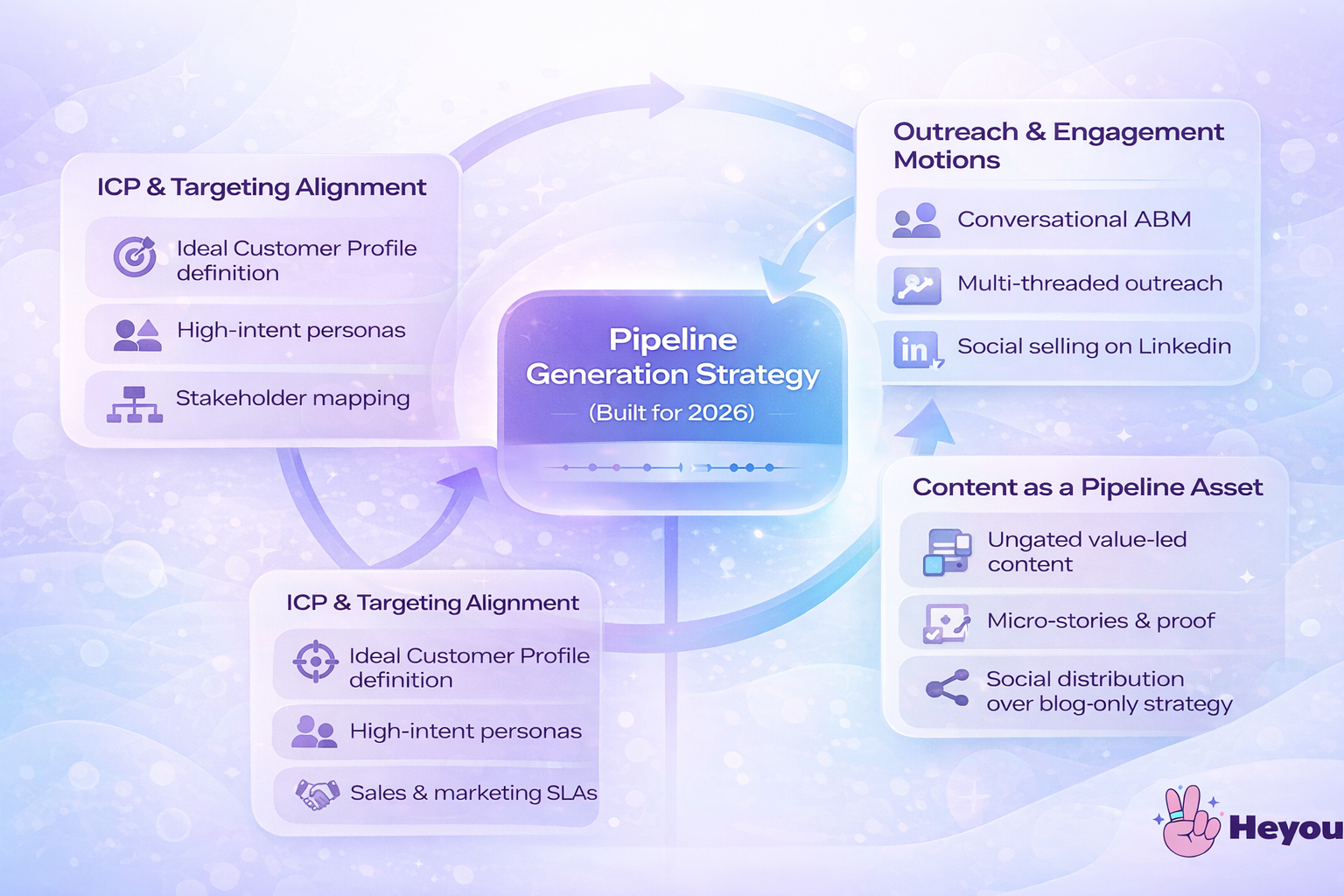
Pipeline generation in 2026 is not about adding more channels or more tools. It is about orchestrating relevance across the entire buyer journey. The most effective strategies align targeting, engagement, and content around one principle: real conversations drive revenue.
ICP and Targeting Alignment
Pipeline quality is determined long before the first message is sent. Strong pipeline generation starts with precision in who you engage and why.
Ideal Customer Profile definition
An Ideal Customer Profile defines the accounts most likely to convert, retain, and expand, not just those that fit basic firmographic filters. In 2026, ICPs are shaped by:
- Business model fit
- Buying readiness
- Willingness to engage in conversations
Pipeline improves when teams stop targeting everyone who could buy and focus on those who are most likely to move forward.
High-intent personas
Not every persona carries the same level of urgency or influence. High-intent personas are defined by:
- Clear ownership of the problem
- Active involvement in evaluation
- Willingness to engage in dialogue
Pipeline generation becomes more efficient when outreach prioritizes who can act, not just who can be contacted.
Stakeholder mapping
Most B2B decisions involve multiple stakeholders with different concerns. Effective pipeline strategies map:
- Decision makers
- Influencers
- Blockers
- Champions
Pipeline strengthens when conversations expand across the buying group instead of staying confined to a single contact.
Sales and marketing SLAs
Misalignment between sales and marketing is one of the fastest ways to weaken pipeline. Clear SLAs establish:
- What qualifies as a real opportunity
- When handoffs happen
- How feedback loops work
When both teams share ownership of pipeline quality, forecasting becomes more reliable and friction drops.
Outreach and Engagement Motions
In 2026, outreach that feels automated is ignored. Engagement that feels human earns responses.
Conversational ABM
Account-based motions work best when they are conversation-first. Conversational ABM focuses on:
- Starting dialogue before pitching
- Tailoring messages to account context
- Building familiarity over time
Pipeline grows when accounts recognize relevance, not when they are overwhelmed with messaging.
Multi-threaded outreach
Single-threaded pipeline is fragile. Multi-threaded outreach:
- Reduces deal risk
- Increases internal momentum
- Keeps opportunities moving when one contact stalls
Healthy pipeline reflects breadth of engagement, not just frequency.
Social selling on LinkedIn
LinkedIn has evolved into a core pipeline channel, not just a branding platform. Effective social selling includes:
- Consistent visibility through posts and comments
- Thoughtful engagement before direct outreach
- Context-aware conversations
Pipeline benefits when buyers recognize names before receiving messages.
Referral and ecosystem plays
Warm introductions convert better than cold starts. Referral-driven pipeline leverages:
- Customers
- Partners
- Industry relationships
These plays work best when trust already exists and conversations feel natural.
Content as a Pipeline Asset
Content no longer exists just to attract traffic. In 2026, content exists to fuel conversations.
Ungated value-led content
Gated content creates friction early in the journey. Ungated content:
- Builds trust
- Signals confidence
- Allows buyers to self-qualify
Pipeline improves when content removes barriers instead of adding them.
Micro-stories and proof
Short, specific stories outperform broad claims. Micro-stories highlight:
- Real use cases
- Specific outcomes
- Practical lessons
These stories give sales teams context and give buyers confidence to engage.
Social distribution over blog-only strategy
Publishing is not enough. Distribution determines impact. Modern pipeline strategies prioritize:
- Social sharing
- Comment-driven engagement
- Conversation-ready formats
Content that sparks dialogue contributes more to pipeline than content that simply ranks.
Pipeline generation scales when conversations scale, and conversations scale only when messaging feels human, contextual, and personal.
This is where Heyou fits naturally. By helping teams engage authentically across channels without sounding scripted or generic, Heyou supports pipeline strategies that prioritize real dialogue over automated noise, strengthening trust while driving revenue forward.
AI and Technology in Pipeline Generation
AI is no longer a differentiator in pipeline generation. It is infrastructure. In 2026, the question is not whether teams use AI, but how well AI is integrated into real pipeline workflows without breaking trust or conversations.
The strongest teams use AI to support judgment, not replace it.
What Is AI Pipeline Generation?
AI pipeline generation refers to the use of artificial intelligence to improve how pipeline is identified, created, prioritized, and progressed, without removing human accountability from revenue outcomes.
It focuses on augmentation, not automation theater.
AI-assisted targeting
AI improves targeting by helping teams:
- Identify accounts with higher likelihood to convert
- Surface patterns across historical pipeline data
- Narrow focus to segments that consistently move forward
Instead of expanding reach, AI-assisted targeting helps teams reduce waste and focus effort where pipeline potential is real.
AI-powered engagement
AI supports engagement by:
- Drafting context-aware messages
- Suggesting conversation angles
- Adapting outreach based on responses
However, AI-powered engagement works only when messages still feel human, timely, and relevant. Generic AI output damages trust faster than no outreach at all.
AI-driven prioritization
Not all opportunities deserve equal attention. AI-driven prioritization helps teams:
- Rank opportunities based on momentum
- Detect stalled deals early
- Focus SDR and AE effort on accounts most likely to progress
This keeps pipeline realistic and prevents over-investing in low-probability deals.
Revenue teams that respond within the first hour of demonstrated buyer intent consistently see significantly higher qualification and opportunity creation rates compared to delayed follow-ups.
AI SDRs and Pipeline Generation
AI SDRs have become widely available, but their impact on pipeline varies significantly depending on how they are deployed.
What AI SDRs actually do well
AI SDRs excel at:
- Handling repetitive outreach tasks
- Operating at consistent scale
- Managing follow-ups and reminders
- Processing large volumes of signals quickly
They are effective at keeping pipeline warm, especially in early engagement and reactivation scenarios.
Where human SDRs still win
Human SDRs outperform AI when:
- Conversations require nuance or judgment
- Objections are complex or emotional
- Stakeholders need reassurance and context
- Trust needs to be built or repaired
Pipeline generation still depends heavily on human intuition and credibility, especially in later-stage conversations.
Hybrid models outperform both
The most effective pipeline teams use hybrid models, where:
- AI handles scale, data, and prioritization
- Humans handle conversations, decisions, and relationship-building
This approach creates pipeline that is both efficient and believable, without sacrificing trust for volume.
By framing AI SDRs as part of a system rather than a silver bullet, the content aligns with how modern buyers actually evaluate these tools.
Related: Best AI SDRs
Intent Data and Buying Signals
Pipeline generation improves dramatically when teams act on intent, not assumptions.
First-party vs third-party intent
- First-party intent comes from direct engagement with your brand, such as content consumption, site behavior, or conversations.
- Third-party intent comes from external signals, such as topic research or platform-level activity.
Both have value, but first-party intent is stronger and more reliable for pipeline decisions because it reflects direct buyer interaction.
Behavioral signals that matter
The most useful signals are those that indicate readiness, not curiosity.
Examples include:
- Repeated engagement over time
- Responses to messages or content
- Stakeholder involvement across an account
- Movement from passive consumption to active dialogue
Pipeline strengthens when signals are interpreted in context, not in isolation.
Why timing beats personalization
Highly personalized outreach sent at the wrong time still fails.
Pipeline generation works best when:
- The message aligns with current buyer priorities
- Outreach matches the stage of evaluation
- Conversations begin when urgency is emerging
In 2026, timing consistently outperforms surface-level personalization.
Predictive Analytics and Forecasting
Predictive analytics helps teams move from reactive pipeline management to forward-looking decision-making.
Pipeline coverage ratios
Coverage ratios help teams understand whether there is enough pipeline to support revenue goals. Predictive models help:
- Adjust coverage targets dynamically
- Identify gaps earlier in the cycle
- Prevent last-minute pipeline scrambling
Healthy pipeline is planned, not hoped for.
Revenue probability scoring
AI-assisted probability scoring evaluates:
- Deal behavior
- Stage movement
- Historical patterns
This creates more realistic forecasts and reduces reliance on gut feel alone.
Sales velocity optimization
Velocity measures how quickly pipeline turns into revenue. Predictive analytics supports velocity by:
- Highlighting bottlenecks
- Identifying stalled stages
- Recommending where to intervene
Faster pipeline is not about pushing harder. It is about removing friction at the right moment.
When AI is used to support conversations instead of replacing them, pipeline becomes more predictable, credible, and scalable. Technology creates leverage, but revenue is still decided in human moments.
Automated Pipeline Generation
Automation is now a permanent part of pipeline generation. But most teams still get it wrong by automating output instead of outcomes.
In 2026, automated pipeline generation is not about sending more messages. It is about removing friction so real conversations can happen faster and more consistently.
What Automation Should Do
When used correctly, automation supports momentum without replacing judgment.
Remove manual follow-ups
One of the biggest pipeline killers is missed follow-up.
Automation should:
- Ensure no conversation drops unintentionally
- Handle reminders and sequencing reliably
- Free SDRs and AEs from chasing tasks instead of opportunities
Good automation makes follow-up inevitable, not optional.
Eliminate CRM hygiene work
Manual CRM updates slow teams down and reduce data quality.
Automation should:
- Log activity automatically
- Update stages based on clear signals
- Reduce the need for reps to “clean data” after the fact
Pipeline visibility improves when data is captured as a byproduct of work, not as extra work.
Increase response speed
Speed still matters in pipeline generation, but only when paired with relevance.
Automation should:
- Route replies instantly
- Trigger timely next steps
- Prevent delays between intent and engagement
Fast response builds trust. Slow response kills momentum.
What Automation Should Never Do
Some things should not be automated, no matter how advanced the system.
Sound robotic
Automation that feels scripted or generic signals low effort.
Buyers recognize:
- Template-driven messages
- Predictable sequences
- Over-polished, unnatural language
Once trust is lost, pipeline rarely recovers.
Ignore context
Automation without context creates friction.
It should never:
- Message buyers mid-conversation as if nothing happened
- Re-send information already acknowledged
- Treat all accounts as interchangeable
Context is not optional. It is the foundation of real pipeline.
Spam at scale
High-volume automation creates short-term activity and long-term damage.
Spamming leads to:
- Lower response rates
- Brand fatigue
- Blocked channels and lost credibility
Pipeline generation depends on permission and relevance, not persistence alone.
Automation should feel like real conversations, not workflows.
The strongest pipeline systems use automation to support human engagement, not replace it. When messages feel contextual, personal, and timely—even at scale—pipeline grows without sacrificing trust.
That is the difference between automated activity and automated pipeline generation.
Pipeline Generation Activities That Actually Work
High-Impact Activities
- LinkedIn conversation starters: Short, relevant openers that invite dialogue instead of pitching.
- Comment-driven demand: Engaging publicly on buyer posts to earn inbound conversations.
- Employee advocacy motions: Using real people—not brand pages—to distribute credibility and reach.
- Warm intro loops: Leveraging customers, partners, and mutual connections to enter deals with trust.
Low-Impact Activities to Avoid
- Spray-and-pray outbound: High volume, low relevance, predictable failure.
- Gated everything: Forces friction before trust exists.
- Generic sequencing: Automation without context kills response rates.
Pipeline Generation Metrics That Matter
Core Metrics
- Pipeline coverage ratio: Do you have enough real opportunities to hit revenue goals?
- Conversion rates: Are deals actually progressing between stages?
- Sales velocity: How fast pipeline turns into revenue.
Marketing Attribution That Makes Sense
- Revenue influence, not vanity attribution: Credit what moves deals forward, not what gets clicks.
- Multi-touch reality: Pipeline is shaped by multiple interactions, not a single source.
Metrics That Matter
| Metric | What It Measures | What “Good” Looks Like |
|---|---|---|
| Pipeline coverage ratio | Pipeline vs revenue target | Consistently predictable |
| Stage conversion | Deal momentum | No major drop-offs |
| Sales velocity | Speed to revenue | Shortening over time |
| Revenue influence | Impact of activities | Clear deal contribution |
Pipeline generation works when conversations drive momentum and metrics reflect revenue, not activity.
Common Pipeline Generation Challenges
Sales and Marketing Misalignment
Different success metrics lead to broken handoffs and weak pipeline ownership.
Quantity Over Quality Focus
More activity creates noise, not revenue, when intent is ignored.
Follow-up Failure
Missed or delayed follow-ups quietly kill deal momentum.
Tool Overload Without Strategy
Too many tools, no clear system, and fragmented pipeline visibility.
Manual Data Entry Errors
Human updates lag reality and distort forecasts.
How to Improve Pipeline Generation (Practical Playbook)
Improving pipeline generation is less about adding new tactics and more about removing friction across the buyer journey. The strongest teams focus on fast fixes first, then invest in systems that scale without breaking trust.
Short-Term Wins
Fix handoffs
Most pipeline leakage happens at the marketing-to-sales handoff.
To fix this:
- Align on what qualifies as a real opportunity
- Define clear ownership at every stage
- Close feedback loops when leads stall or disqualify
Pipeline improves immediately when responsibility does not disappear at handoff.
Improve response timing
Response timing is one of the few levers that still consistently impacts pipeline.
Improvement does not mean instant replies to everything. It means:
- Fast responses when intent is high
- Clear next steps after every interaction
- No dead time between buyer action and seller response
Momentum is fragile. Slow responses quietly kill deals.
Humanize the first touch
The first interaction sets the tone for the entire pipeline.
Human-first outreach:
- References context, not personas
- Sounds like a person, not a workflow
- Invites conversation instead of pushing a pitch
Pipeline quality improves when buyers feel seen, not processed.
Long-Term Scale
Conversation-led GTM
In 2026, scalable pipeline is built around conversations, not campaigns.
Conversation-led GTM:
- Treats dialogue as the primary conversion event
- Designs content and outreach to spark responses
- Measures success by engagement quality, not impressions
This shift turns pipeline into a living system instead of a static funnel.
AI-supported personalization
AI creates leverage when it supports relevance, not when it imitates intimacy.
Effective AI-supported personalization:
- Uses signals to guide timing and focus
- Assists message framing without scripting
- Helps prioritize effort across accounts
When AI amplifies judgment instead of replacing it, pipeline becomes both scalable and credible.
Community and social proof
Buyers trust what they see others engaging with.
Long-term pipeline scale comes from:
- Visible conversations in public channels
- Employee participation, not just brand posts
- Proof embedded in everyday interactions
Social proof reduces friction long before sales conversations begin.
Inbound vs Outbound Pipeline Generation
Pipeline generation rarely succeeds with only one motion. The real advantage comes from understanding the trade-offs and combining both intelligently.
Inbound Strengths and Limits
Inbound pipeline benefits from:
- Higher intent
- Buyer-led timing
- Strong trust signals
Its limitations:
- Slower to scale predictably
- Dependent on content discovery
- Less control over volume and timing
Inbound creates quality, but not always consistency.
Outbound Strengths and Limits
Outbound pipeline offers:
- Control over targeting
- Faster feedback loops
- Predictable activity levels
Its limitations:
- Lower trust at first contact
- High sensitivity to relevance
- Rapid drop-off if messaging feels automated
Outbound works best when it starts conversations, not when it forces them.
The Hybrid Model That Wins in 2026
High-performing teams combine both motions.
- Inbound builds context and credibility
- Outbound initiates timely conversations
- Content supports both
Pipeline scales when buyers recognize you before you reach out and understand you when you do.
Pipeline Generation Best Practices for B2B Teams
- Start conversations, not campaigns
- Optimize for replies, not reach
- Let AI assist, not replace trust
- Measure what converts, not what looks good
These practices protect pipeline quality as volume increases.
Frequently Asked Questions
What is pipeline generation?
Pipeline generation is the process of creating, qualifying, and progressing sales opportunities toward revenue in a predictable and measurable way.
Unlike lead generation, which focuses on capturing interest, pipeline generation focuses on deal readiness, momentum, and conversion. It measures success by how opportunities move through the sales process, not by how many contacts enter the funnel.
Pipeline generation vs lead generation: what’s the difference?
Lead generation captures attention, while pipeline generation creates revenue-ready opportunities.
Lead generation optimizes for volume, such as form fills or sign-ups. Pipeline generation optimizes for opportunities that actively progress toward a close. One measures activity. The other measures revenue impact.
What is a good pipeline generation strategy?
A good pipeline generation strategy aligns targeting, conversations, and deal progression across marketing and sales.
Strong strategies focus on:
- High-intent accounts
- Conversation-led engagement
- Clear qualification standards
- Consistent follow-up and momentum
The goal is not more pipeline, but more reliable pipeline.
What tools help with pipeline generation?
Pipeline generation tools should support conversations, context, and prioritization.
Effective tools help teams:
- Identify which accounts to focus on
- Engage buyers at the right time
- Track deal progression accurately
Tools that automate activity without preserving context often weaken pipeline instead of strengthening it.
How does AI improve pipeline generation?
AI improves pipeline generation by assisting targeting, timing, and prioritization, not by replacing human judgment.
AI helps teams:
- Focus on higher-probability accounts
- Respond faster when intent is high
- Keep pipeline clean and realistic
The best results come from AI-supported, human-led workflows.
What metrics define good pipeline health?
Good pipeline health is defined by coverage, conversion, and velocity.
Key indicators include:
- Pipeline coverage relative to revenue goals
- Stage-to-stage conversion rates
- Sales velocity and deal momentum
Healthy pipeline supports accurate forecasting and confident decision-making.
How long does pipeline generation take?
Pipeline generation timelines vary by market, deal size, and motion, but consistency matters more than speed.
Some pipelines develop quickly through outbound conversations. Others take longer through inbound and nurturing. What matters is steady momentum and predictable progression, not instant results.
Is pipeline generation inbound or outbound?
Pipeline generation works best when inbound and outbound motions are combined.
Inbound builds trust and context.
Outbound initiates timely conversations.
The strongest teams use a hybrid approach where inbound supports outbound and outbound activates inbound interest.
Can AI SDRs replace human SDRs?
AI SDRs cannot fully replace human SDRs, especially in complex B2B sales.
AI SDRs are effective at:
- Scale
- Follow-ups
- Signal processing
Human SDRs win when:
- Trust is required
- Objections are nuanced
- Stakeholders need reassurance
Hybrid models consistently outperform either alone.
What is scalable pipeline generation?
Scalable pipeline generation means growing pipeline volume without sacrificing relevance, trust, or conversion quality.
It relies on:
- Clear ICPs
- Conversation-led engagement
- AI-assisted prioritization
- Systems that support humans, not replace them
Scalability is achieved when conversations scale as well as activity.
Final takeaway
Pipeline generation succeeds when teams optimize for conversations, momentum, and trust instead of traffic and volume.
Tools like Heyou support this shift by helping teams scale real, context-aware conversations without turning pipeline generation into automated noise.
January 09, 2026
| |18 min read
| |Articles
Check our recent articles

Stop begging colleagues for posts likes.
Auto-like your corporate posts and boost your social performance.