Table of contents
TL;DR - "AI sales agent" sounds like one thing that replaces a salesperson. Selling is not one thing. It is a dozen jobs, and AI has taken some of them completely, co-pilots others, and cannot touch a few. Here is the honest map: AI owns the admin, research, and data end to end. It co-pilots the writing, the materials, and the pipeline, where you approve before anything goes out. It cannot own the trust: discovery, negotiation, and the close. So when a vendor says "AI sales agent," the only useful question is which bucket they actually mean.
An AI sales agent is only as honest as the part of the job it names. The busywork can be automated. The moment a person decides to trust another person cannot.
What is an AI sales agent?
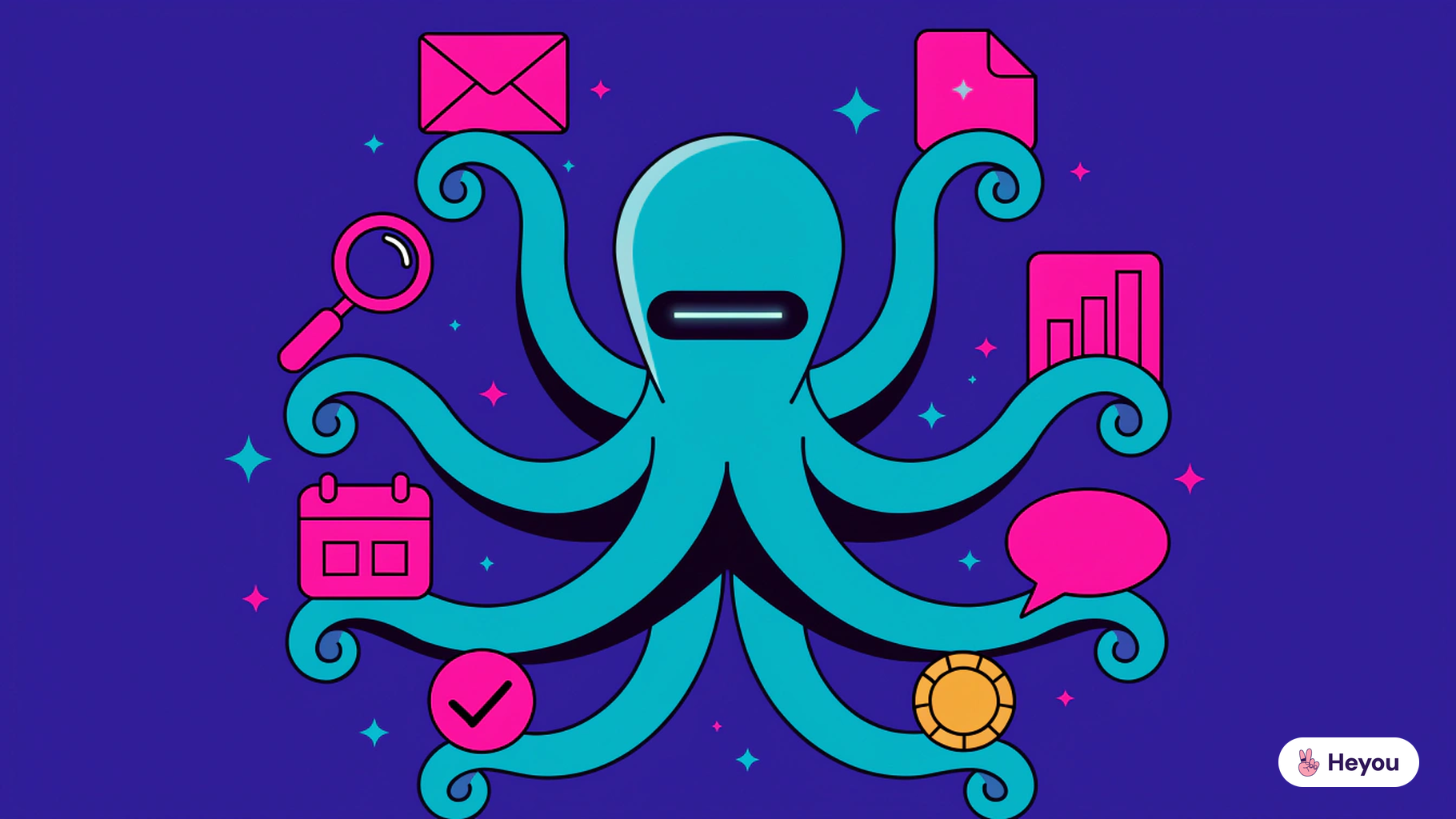
An AI sales agent is software that takes actions across the sales workflow, not just generates text. It can research an account, draft the outreach, log the activity, summarize the call, and tell you what to do next. That is a real step beyond a chatbot that writes a paragraph when you ask.
AI agents for sales have gone from demo to daily tool fast, and AI sales agents now get pitched as a full replacement for a rep. The problem is the word "agent" gets stretched to imply exactly that. It does not replace the seller, and to see why, you have to break selling into the jobs it is actually made of.
Selling is not one task, it is a dozen
When someone says an AI agent will "do sales," ask them to name the task. Selling in B2B includes prospecting and list building, research and meeting prep, writing outreach, networking and getting introductions, discovery, objection handling and negotiation, closing, converting and moving deals forward, follow-ups, call summaries, logging activity and keeping the CRM clean, managing the pipeline so nothing drops, forecasting, and building materials like decks and proposals.
That is the real job. Before you can judge an AI sales agent, you have to split that list by how much of each task a machine can actually own.
The three buckets
- Agentic. AI does it end to end. You check it, you do not do it. These are the repetitive, data-heavy tasks where speed and consistency beat human touch.
- Human in the loop. AI does the heavy lifting and produces a draft, but a human approves or edits before anything reaches a buyer. This is most of the creative and judgment work.
- Human. AI can prepare you, but the act itself has to be you. This is where trust lives, and trust does not transfer to a bot.
What can an AI sales agent actually do?
| Sales task | What it takes | Where it sits now |
|---|---|---|
| Prospecting and list building | Pattern-matching an ICP across large data | Agentic |
| Research and meeting prep | Pulling and summarizing public signals before a call | Agentic |
| Call summaries and notes | Transcribing and structuring what was said | Agentic |
| Activity logging and CRM hygiene | Recording what happened, keeping records clean | Agentic |
| Writing outreach and follow-ups | Drafting in context, then a human check before send | Human in the loop |
| Building materials (decks, one-pagers, proposals) | Assembling a first version a human sharpens | Human in the loop |
| Pipeline management | Surfacing what is slipping so a human decides the move | Human in the loop |
| Forecasting | Compiling the numbers while a human owns the call | Human in the loop |
| Networking and getting introductions | Earning and spending trust between real people | Human |
| Discovery | Reading a room and asking the question behind the answer | Human |
| Objection handling and negotiation | Judgment and nerve in real time | Human |
| Closing | A person deciding to trust another person | Human |
Can an AI sales agent replace a salesperson?
Almost everything sold as an "autonomous sales agent" lives in the first two buckets. That is not a criticism. Clearing the admin and the research is genuinely valuable, and it gives a seller back the hours that used to vanish into tabs and data entry. A good agent can hand a rep a prepared account, a drafted first touch, and a clean pipeline view every morning.
What no agent owns is the bottom of that table, and that is the part that wins the deal. A six-figure decision is still made by a person in a conversation, and whether you win it comes down to trust you build in the room. Gartner projects that by 2030, 75% of B2B buyers will prefer sales experiences that prioritize human interaction over AI. The busywork gets automated. The buyer still wants a human for the part that matters.
So the question to ask a vendor is never "does it do sales." It is "which of these twelve jobs does it actually do, and which are you quietly leaving to me."
AI sales agent vs AI SDR
The terms get mixed up, so it is worth being precise. An AI SDR is narrow by design: it automates the top of the funnel, finding prospects and trying to book meetings. An AI sales agent is a broader claim that reaches across the workflow, from research through pipeline management. Broader claim, same test: name the task. If you want the top-of-funnel comparison in detail, see the best AI SDR tools.
The honest way to build with AI in sales is to automate hard across the agentic bucket, co-pilot the middle with a human check, and protect the human bucket fiercely. That is what agentic sales actually means, it pairs with a strong go-to-market system, and it only pays off when the human still has the sales techniques to win the conversation the agent set up.
← Back to the Agentic Sales guide
What is an AI sales agent?
An AI sales agent is software that takes actions across the sales workflow, not just generates text: researching accounts, drafting outreach, logging activity, summarizing calls, and surfacing the next step. The honest version owns the admin and data, co-pilots the writing and the pipeline, and leaves the trust-based moments to a human.
What can an AI sales agent actually do?
Today it reliably does the repetitive, data-heavy work end to end: prospecting against an ICP, research and meeting prep, call summaries, and CRM hygiene. It drafts outreach, materials, and follow-ups for a human to approve. It cannot own discovery, negotiation, or closing, because those run on trust between people.
What is the difference between an AI sales agent and an AI SDR?
An AI SDR is narrow: it automates top-of-funnel outbound, finding prospects and booking meetings. An AI sales agent is a broader claim across the whole workflow, from research to pipeline management. The label is wider, so the first question to ask any vendor is which parts of the job it actually covers.
Will AI sales agents replace salespeople?
No, and the trend points the other way. AI removes the busywork, which makes the human hours worth more, not fewer. Gartner projects that by 2030, 75% of B2B buyers will prefer sales experiences that prioritize human interaction over AI. The admin gets automated. The relationship does not.
What can an AI sales agent not do?
It cannot earn trust, read a room, handle a live objection with nerve, or make a person decide to buy from another person. It can prepare you perfectly for all of those. The act itself stays human, and that is the part that wins six-figure deals.