
Table of contents
TL;DR - The cheap-leads era is over. Ten years ago you could buy a list, spray it, and fill a pipeline. Buyers changed, and now buying leads and data is something everyone can do, so it sets no one apart. What makes lead generation work today is trust: being the name a buyer already believes in before they are ready to talk. This guide covers what lead generation channels are available today in the B2B world, every channel you can use ranked by cost and speed, and how to measure it.
I will admit something, because I had a big hand in it. 10 years ago we lived through the booming age of list generation. Create channels to drive loads of leads, some colder and some warmer. Then load those into well planned sequences run by teams of SDRs, hit the send button, and count the meetings. It worked for a long time, until it didn't. I was really good at it. But that era is over.
Buyers, including myself, got tired of being a name in someone's list, and the AI made such execution nearly free. When everyone can execute the same play, the play stops working. So the only question worth asking is what can make you unique?
Lead generation is finding and attracting potential buyers and getting them into your pipeline. What changed is not the goal, it is what earns it: trust.
What actually makes your lead generation work?
Most advice about lead generation is about targeting:
- the right timing
- the right search terms
- the right job titles and company sizes.
That is all real, and it is all table stakes. It is not what decides whether someone talks to you. What decides that is whether they already trust you when your name comes up, or recognize your name when you message them.
The fastest way to feel this is to look at your own behaviour, so let us do that.
✦ Check yourself
When you choose your top 3 vendors, what do you do?
So the real work of lead generation is not getting in front of more people. It is becoming the answer when a buyer asks the people and sources they trust. Everything below serves that.
Every lead generation channel, and how to make it work
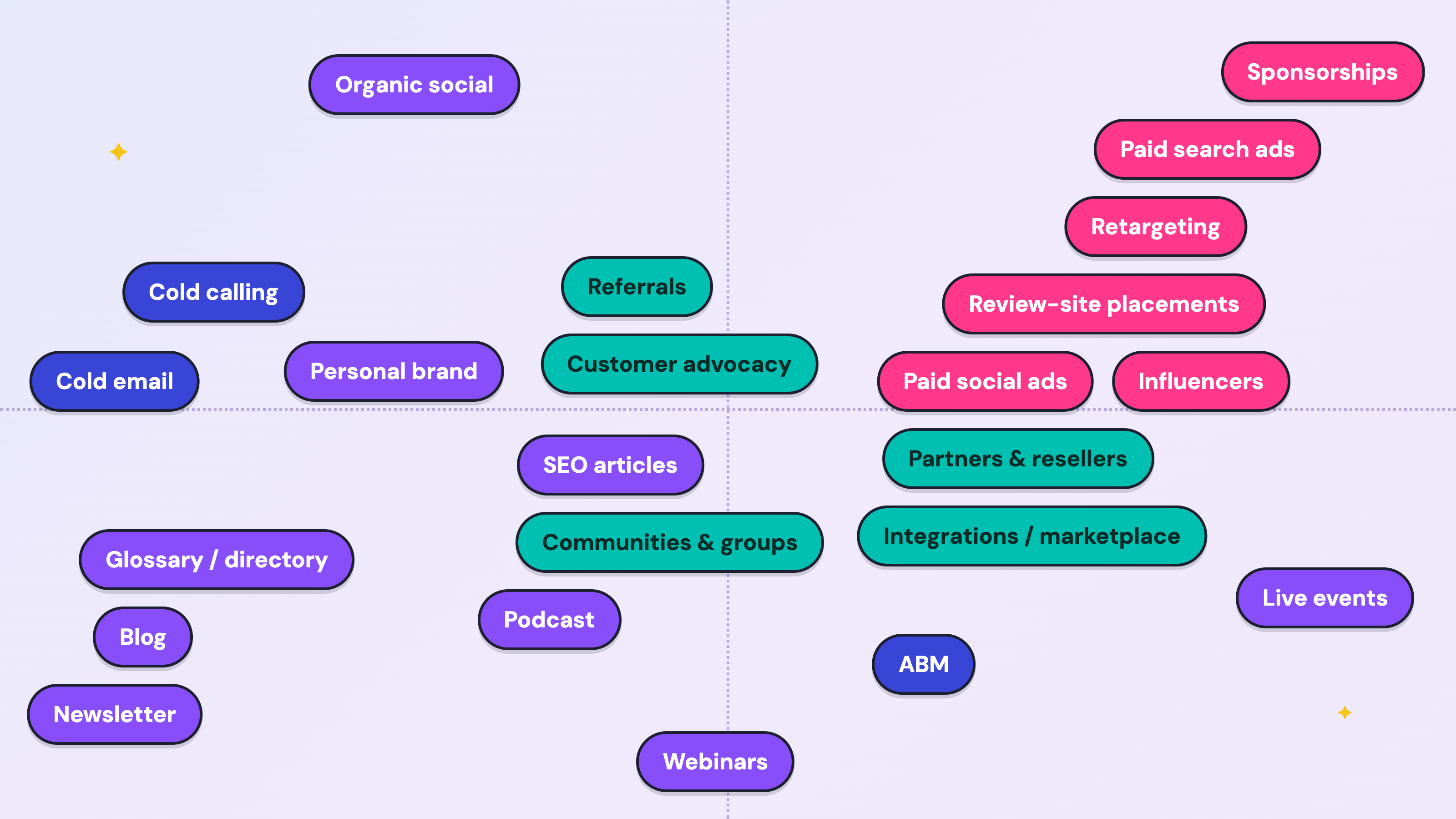
There are more ways to generate B2B leads than any one team could run, and they are not equal. Some are cheap to run, some expensive; some pay off fast, most take time. The map below plots every channel on two axes at once: how much it costs to run, and how long it takes to work. The full breakdown follows, grouped into owned, earned, paid, and outbound.

The cheap-and-fast corner is crowded, because everyone can do it. The channels that compound, content and SEO, referrals and word of mouth, community, and honest outbound, sit in the slower half, and that is exactly why they are worth more: they build trust, and trust does not switch off the day you stop paying.
Owned tactics
Owned tactics are the channels you fully control: your content, your audience, your presence. They cost mostly time and creativity rather than cash, they compound over time, and they build the trust that makes every other channel work harder. Slow to start, but they keep paying long after the work is done.
Shortlist of owned tactics:
Organic social
At a glance: Easy to execute | Sprint results | Good for visibility
Making it work: Cheap to start and fast to get seen, and with real creativity it becomes a genuine inbound engine. The cost here is creativity, because simply amplifying blog posts stopped working a while ago. Give real value and it turns into real conversations. The strongest version is thought-leadership content from your executives and subject-matter experts, in their own voice.
SEO articles
At a glance: Easy to execute | Long-term investment | Compounds over time
Making it work: Write the piece that answers your buyer's search better than anything else ranking. It is slow, so choose topics with real buying intent, not just volume, and build depth around a few clusters instead of one-off posts. Don't make everything about your product: give buyers real insights, practical assets, and guides that genuinely help them.
Blog
At a glance: Easy to execute | Long-term investment | Builds trust
Making it work: Make this the home for your thought-leadership articles. Take a stance the rest of the market will not, write for one specific reader with one specific problem, and let each post do double duty in search, in social, and in your newsletter.
Newsletter
At a glance: Easy to execute | Long-term investment | Builds trust
Making it work: Don't lose trust over this one. No matter how someone got onto the list, it is the easiest list to leave, so every send has to be worth opening and not worth unsubscribing from. Make it about them, not you. It is not a reply game here; it is "I have something no one else has, and you have to open it."
Glossary / directory
At a glance: Easy to execute | Long-term investment | Good for visibility
Making it work: Definition and comparison pages quietly capture buyers searching exact, high-intent terms. They are cheap to produce and easy to keep current, and they interlink naturally with your deeper content. Treat each one as a real answer, not a keyword trap.
Podcast
At a glance: Harder to execute | Long-term investment | Builds trust
Making it work: Few formats build a relationship like a voice in someone's ears every week. It is a long game, so commit to a full season before judging it, and book guests your buyers already respect to borrow their audience. The real payoff is often off-mic: the relationships you build with the guests themselves.
Webinars
At a glance: Harder to execute | High impact | Long-term investment
Making it work: Live teaching that proves your expertise while people watch. Keep it genuinely useful and product-light, because attendees are usually close to a decision and can smell a disguised demo. The recording then works for months as open or gated content, so one hour of effort keeps paying.
Live events
At a glance: Hard to execute | Bigger investment | High impact
Making it work: Nothing builds trust faster than a real room. The biggest mistake is making people work: get them off-work instead, with an experience worth showing up for. Start small, because a curated dinner or a focused workshop beats a big flashy conference for pipeline, and design for conversation, not stage time.
Personal brand
At a glance: Easy to execute | Long-term investment | Builds trust
Making it work: You, showing up consistently as a real person your market recognizes, is the multiplier on everything else. It costs mostly time and a willingness to hold a point of view. Pick one or two places to be genuinely present, teach what you know, and let people meet the human before they ever meet the pitch.
Earned tactics
Earned tactics are the ones other people carry for you: referrals, word of mouth, community standing, partners. You cannot buy them and you cannot fully control them, which is exactly why they carry the most trust. They are the slowest to build and worth more than anything you can pay for.
Shortlist of earned tactics:
Referrals
At a glance: Hard to execute | Quick wins | High impact
Making it work: The highest-trust lead there is, and most companies simply never ask. Make the ask specific and easy, at the moment a customer is happiest, and give them both a reason and a simple way to introduce you. A small, deliberate referral habit beats an elaborate program nobody uses.
Communities & groups
At a glance: Long-term investment | Builds trust | Requires consistency
Making it work: Show up where your market already gathers and be useful before you are visible. Standing is earned over months by answering questions and adding value, not by dropping links. Do it well and you become the trusted regular people tag when a need comes up.
Customer advocacy
At a glance: High impact | Builds trust | Long-term investment
Making it work: Turn your happiest customers into your loudest channel through stories, reviews, and public shout-outs. Make them the hero of the story, not your product, and make sharing effortless. Proof from a peer outsells anything you could ever say about yourself.
Partners & resellers
At a glance: Hard to execute | Long-term investment | Requires cooperation
Making it work: Other companies putting you in front of their audience, with their credibility attached. It takes real relationship-building and internal alignment, so start with a handful of partners who serve the same buyer for a different need. Shared wins keep it alive; one-sided deals die quietly.
Integrations / marketplace
At a glance: Hard to execute | Long-term investment | Requires cooperation
Making it work: Being present inside the tools your buyers already live in puts you in front of qualified users exactly when they need you. It is real engineering and review work, so build the integrations your customers actually ask for first. A strong marketplace listing then keeps referring users on its own.
Paid tactics
Paid tactics buy you attention and speed. They are the fastest way to test a message or fill a gap, and the moment you stop paying they stop working. Used well they amplify trust you have already built; used alone they rent attention that never quite sticks.
Shortlist of paid tactics:
Paid search ads
At a glance: Easy to execute | Sprint results | Costs money not time
Making it work: The fastest way to reach people actively searching for what you sell. Intent is high and so is competition, so protect your budget with specific, buying-stage terms and a landing page that actually matches the search. Treat it as a way to capture demand, not create it.
Paid social ads
At a glance: Easy to execute | Sprint results | Costs money not time
Making it work: Fast to launch and precise to target, but you are interrupting people who were not looking for you. Lead with a scroll-stopping idea and real value, not a demo request, and use it to put your best content in front of the right audience. Attention rented this way needs trust behind it to convert.
Retargeting
At a glance: Easy to execute | Quick wins | Low cost
Making it work: The cheapest paid win there is: gently reminding people who already showed interest. Keep the frequency sane so it feels helpful rather than creepy, and point them to the next useful step, not the same ad again. It only works if you have traffic worth retargeting, so pair it with everything else.
Sponsorships
At a glance: Bigger investment | Sprint results | Good for visibility
Making it work: Pay to put your name where your market already pays attention, from newsletters to events to creators. The win is borrowed credibility, so choose sponsorships your audience already trusts and show up with value, not just a logo. Measure it on conversations started, not impressions bought.
Review-site placements
At a glance: Bigger investment | Sprint results | High intent
Making it work: Buyers check these sites right before they decide, so presence there reaches people already in buying mode. It costs money and ongoing attention to keep reviews current, but few channels sit closer to the purchase. Earn genuine reviews first, then pay to be seen; the reverse rings hollow.
Influencers
At a glance: Bigger investment | Sprint results | Borrows trust
Making it work: A trusted voice can put you in front of exactly the right audience, fast, with some of their credibility attached. Fit is everything, because the wrong match reads as an ad and earns nothing. Give them room to be honest in their own voice instead of scripting them, and it lands.
Outbound tactics
Outbound is you reaching out to people who never raised a hand. It is direct and fast to start, but it earns no trust on its own.
Shortlist of outbound tactics:
ABM
At a glance: Hard to execute | Long-term investment | Requires cooperation
Making it work: Pick a short list of dream accounts and go deep. The real work is finding a path in, through your network, a customer who can introduce you, or a moment where you meet them in person, rather than defaulting to cold outreach. It is slow and coordinated across sales and marketing, so reserve it for accounts genuinely worth the investment.
Cold email
At a glance: Easy to execute | Sprint results | Low cost
Making it work: Cheap and fast to start, and mostly ignored: average cold email reply rates sit in the low single digits. Before you pour hours into it, weigh that time against the cheaper channels on this list that can generate better results. If you do send, research beats volume: a short, specific note that shows you understand someone's world beats a thousand templated sends.
Cold calling
At a glance: Easy to execute | Quick wins | Low impact
Making it work: Direct and immediate, and easy to dismiss without a real reason to care. It works best once your name already means something, as a follow-up rather than a first touch. Lead with why you are calling them specifically, and earn the next two minutes instead of pitching the whole thing.
How do you measure lead generation?
This is where most teams fool themselves, in two ways.
The first is measuring the wrong thing. Raw lead volume tells you almost nothing. What matters is how many turn into real conversations, how many of those become pipeline, and what a good lead actually costs you once you count the ones that go nowhere. The metric to protect is cost per good lead, not cost per lead.
Stop counting calls, pickups, or replies. Start counting conversations. A reply is not interest, and a pickup is not a meeting. The only top-of-funnel number worth watching is how many real conversations a channel starts, because that is the first thing that actually predicts pipeline.
Fake outcomes
- Emails sent
- Cold/warm leads
- Replies
- Dials
- Activity logged
Real outcomes
- Accounts with access
- Conversations
- Meetings that happened
- New pipeline
- Referrals / intros
The second is measuring too early. In B2B a deal takes three to six months, so a brand-new channel has not had time to produce a single sale yet. If you judge it on revenue in month one, you will kill channels that were about to work. Early on you watch leading indicators, engagement, replies, qualified conversations, and you give the channel a full sales cycle before you read it on pipeline. Different stages of a channel's life get measured by different things.
Common lead generation mistakes
- Buying lists and calling it lead generation. It is cold, everyone has the same data, and it earns no trust.
- Judging a new channel too early. Three to six months is a sales cycle. Read revenue before then and you will cut the wrong things.
- Chasing volume over fit. A thousand cold names is worse than fifty people who already know you.
- Treating every lead the same. Someone a customer referred and someone who filled a form are not the same lead, and running them through the same motion wastes both.
- No follow-up. The unglamorous one that quietly loses the most pipeline.
What is the difference between lead generation and demand generation?
Demand generation creates the interest and trust in the first place. Lead generation captures the people who are ready to act and gets them into your pipeline. You need both, but the mistake is treating lead capture as the whole job and ending up with a list of cold names nobody wants to call.
What are the best B2B lead generation channels?
There is no single best channel. The right mix depends on your budget, your company's goals, and GTM strategy. Then it comes down to how cheap or expensive a channel is to run and how fast or slow it pays off.
How do you measure a new lead generation channel?
It depends on the stage your product is at. If you have reached product-market fit then you measure on early sales and traction, but if you have not, traction alone might be enough. In B2B a deal takes three to six months, so a new channel has not had time to produce revenue. Early on you watch leading indicators such as engagement, replies, and qualified conversations, and you give the channel a full sales cycle before you judge it on pipeline or revenue.
How long before a lead generation channel shows results?
Plan for a full B2B sales cycle, roughly three to six months, before you judge a channel on revenue. Channels that build trust, like content and referrals, are slower to start and then compound; paid channels start faster and stop the moment you stop paying.
Is buying leads still worth it?
Rarely. Buying leads and data is something everyone can now do, so it differentiates no one, and the lists are cold. The advantage has moved to whoever earns trust first. Spend the effort on becoming the name a buyer already trusts, not on a bigger list.