
Table of contents
TL;DR
Sales enablement is the ongoing work of helping your sales team do a better job: the training, the content, the coaching, and the time to sell that reps need to win more deals. It is not a software category, and it is not sales operations. The best enablement answers one question, what can I do to help my team win the room, and then invests in the few things that actually move win rate instead of piling on tools nobody opens.
What is sales enablement?
Sales enablement is everything you do to help your sales team sell better. That means the onboarding that gets a new rep productive, the content they bring into live deals, the coaching that sharpens their calls, and the time and skills they need to do the actual work of selling.
Here is the mindset I come back to every time. When I think about enablement, I think about one question: what can I do to help my team do a better job? Your team and their goals are your customers. Your budget is what you have, and now you choose what to spend it on. That framing changes everything, because it stops you from asking "which tool should we buy" and starts you asking "what does this specific team need to win more often".
The honest definition is simpler than most people make it. Sales enablement is the function that makes each rep more effective, deal by deal, so the whole team converts more of what it touches.
What does sales enablement actually cover?
The trap is that people focus only on tools, when a team needs so much more. A software license does not teach a rep how to run a discovery call, handle a hard objection, or read a buying committee. People do that. So real enablement covers a wider surface than the market usually admits.
The parts that do the heavy lifting:
- Onboarding and ramp Getting a new rep from day one to their first closed deal as fast as the deal cycle allows, without skipping the fundamentals they will lean on for years.
- Ongoing training Not a one-time bootcamp, but a steady rhythm of sharpening skills as the market, the product, and the buyer change.
- The content reps use in deals Short, usable assets built for a live conversation, not a library that looks impressive and goes untouched.
- Coaching on real calls The single highest-impact move in enablement, because it improves the rep in the exact situations they face.
- Time to learn new skills Reps need protected time to get better, not just quota pressure and more activity.
- Time to build relationships Events, rooms, and introductions where real relationships start. This is the part almost every enablement plan forgets, and it is often where the best pipeline actually comes from.
That last point matters more than it looks. You can enable a team with the best content in the world, but if they never get time in the rooms where buyers and champions are, you have armed them and then kept them inside. Enablement beyond tools means budgeting for the human parts of selling too.
Where sales enablement goes wrong
Almost every failed enablement effort fails the same way: tools without adoption.
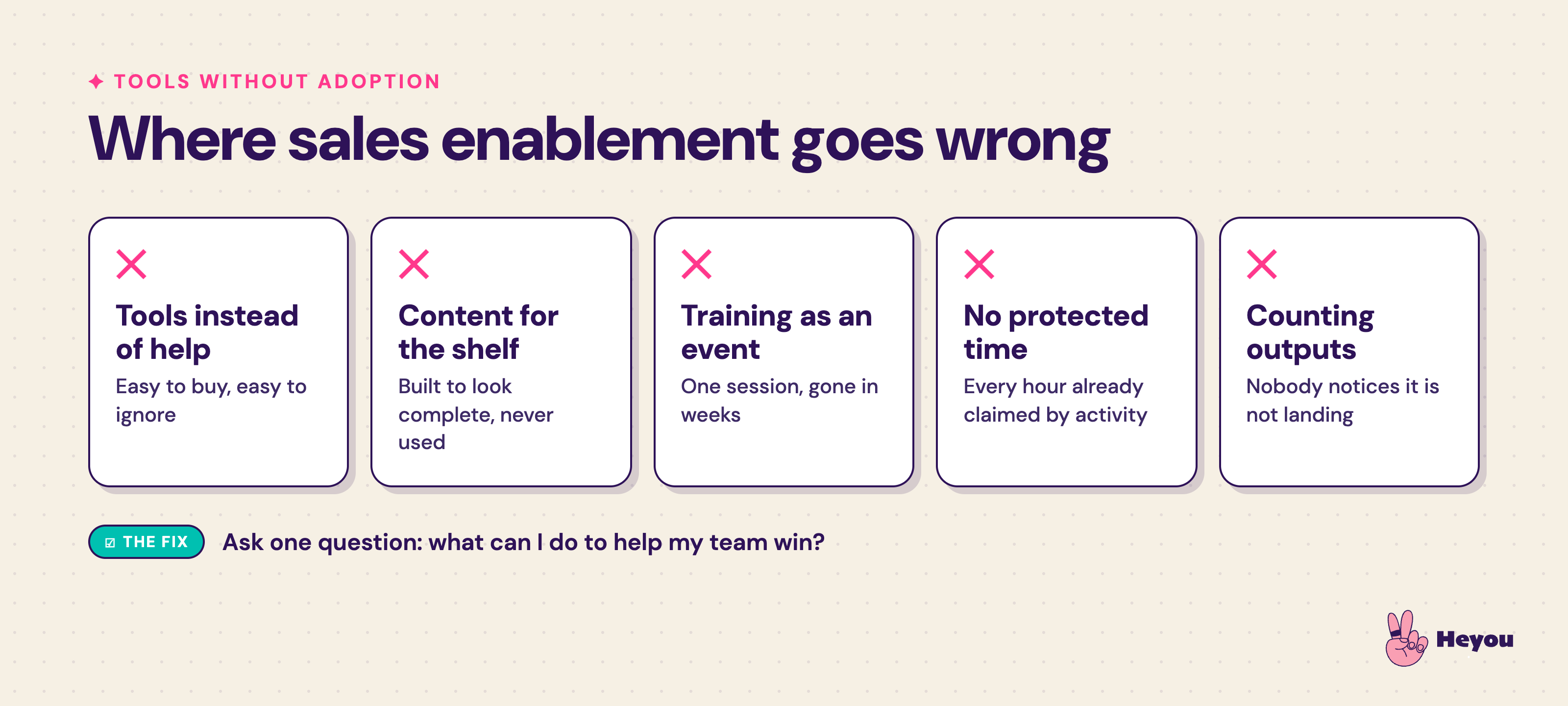 A team buys a stack of software, announces it, and assumes the rest will take care of itself. Six months later the licenses are paid, the usage is near zero, and win rate is exactly where it started.
The common causes:
- Tools instead of help. Buying software is easy to do and easy to point at in a budget review. Actually helping a team get better is slower and less visible, so it gets skipped.
- Content for the shelf. Assets built to look complete rather than to be used in a live deal.
- Training as an event, not a habit. A one-time session with no reinforcement fades within weeks.
- No protected time. Reps are asked to get better while every hour is already claimed by activity targets, so the learning never happens.
- No measurement that matters. Counting outputs instead of tracking ramp, win rate, and adoption, so nobody notices the effort is not landing.
The fix is not more budget. It is going back to the one question, what can I do to help my team do a better job, and spending on the answer, whether that answer is training, coaching, time in the right rooms, or yes, sometimes a tool.
Sales enablement vs sales operations vs RevOps
These three get mixed up constantly, and the confusion wastes money, because teams buy one when they needed another. The clean way to separate them is to ask what each one works on.
Sales enablement works on the rep. It makes the person in the room better: more skilled, better prepared, more useful to the buyer. Its output is a sharper, more confident seller.
Sales operations works on the machine. It owns the process, the data hygiene, the territory and quota design, the stage definitions, and the tech stack that the selling runs on. Its output is a system that runs cleanly.
Revenue operations works on the whole revenue engine. It aligns marketing, sales, and customer success around one view of the funnel and one source of truth, so the handoffs stop leaking. Its output is a connected engine, not three teams optimizing in isolation.
A simple test: if the problem is "our reps are not good enough at X", that is enablement. If the problem is "our pipeline data is a mess and routing is broken", that is ops. If the problem is "marketing, sales, and success are pulling in different directions", that is RevOps. Most teams have all three problems at once, which is exactly why they get blurred.
| Function | Works on | Owns | Output |
|---|---|---|---|
| Sales enablement | The rep | Training, content, coaching, selling time | A sharper seller |
| Sales operations | The machine | Process, data, territories, tech stack | A system that runs clean |
| Revenue operations | The whole engine | Cross-team alignment, single source of truth | A connected funnel |
What enablement content actually gets used?
Most enablement content is built to look thorough and ends up unused. The reason is simple: a rep in the middle of a live deal does not open a 40-page deck or dig through a wiki. They reach for the one thing that helps them in the next 10 minutes.
So build for the moment of use, not for the shelf:
- A one-page value summary a rep can send after a first call, written in the buyer's language.
- Objection answers that are short, specific, and honest, mapped to the objections your team actually hears.
- A relevant customer story matched to the buyer's industry or situation, not a generic case study.
- A clean way to frame price so reps stop improvising the hardest conversation in the deal.
- A simple next-step structure so every call ends with a clear move, not "let me send some info".
The rule that keeps content useful: if a rep would not pull it up during a deal, it is not enablement content, it is marketing collateral. Both can exist, but do not confuse one for the other and then wonder why win rate did not move.
What does sales enablement look like in the AI era?
The useful question is not whether to use AI in enablement, it is what to hand off and what to protect. AI is very good at clearing the administrative weight around selling: drafting a first version of a call summary, pulling account research into one place, prepping a rep before a meeting, and taking notes so the rep can stay present. That is real time given back, and time is the scarcest thing a seller has.
What does not move to AI is the moment that decides the deal. Understanding a person, reading a room, earning trust, and finding the way into an account that was not obvious. Humans are still the ones who close, and they are still the ones buyers want to talk to. So the smart move is to automate the busywork and protect the room.
This is also where enablement and access meet. A rep's hardest problem is often not "what do I say", it is "how do I get into this account at all". Heyou clears the administrative busywork and hands the rep the next action, and it turns intros and referrals into a repeatable channel instead of a lucky accident, so more of a rep's enabled time is spent in real conversations that can actually close. The tool does the busywork. The rep still wins the room.
How do you measure sales enablement?
Enablement gets measured badly more than almost any function, because it is easy to count outputs and hard to count impact. The number of assets produced and the number of people who sat through a training tell you nothing about whether reps got better.
Measure what changes in the field instead:
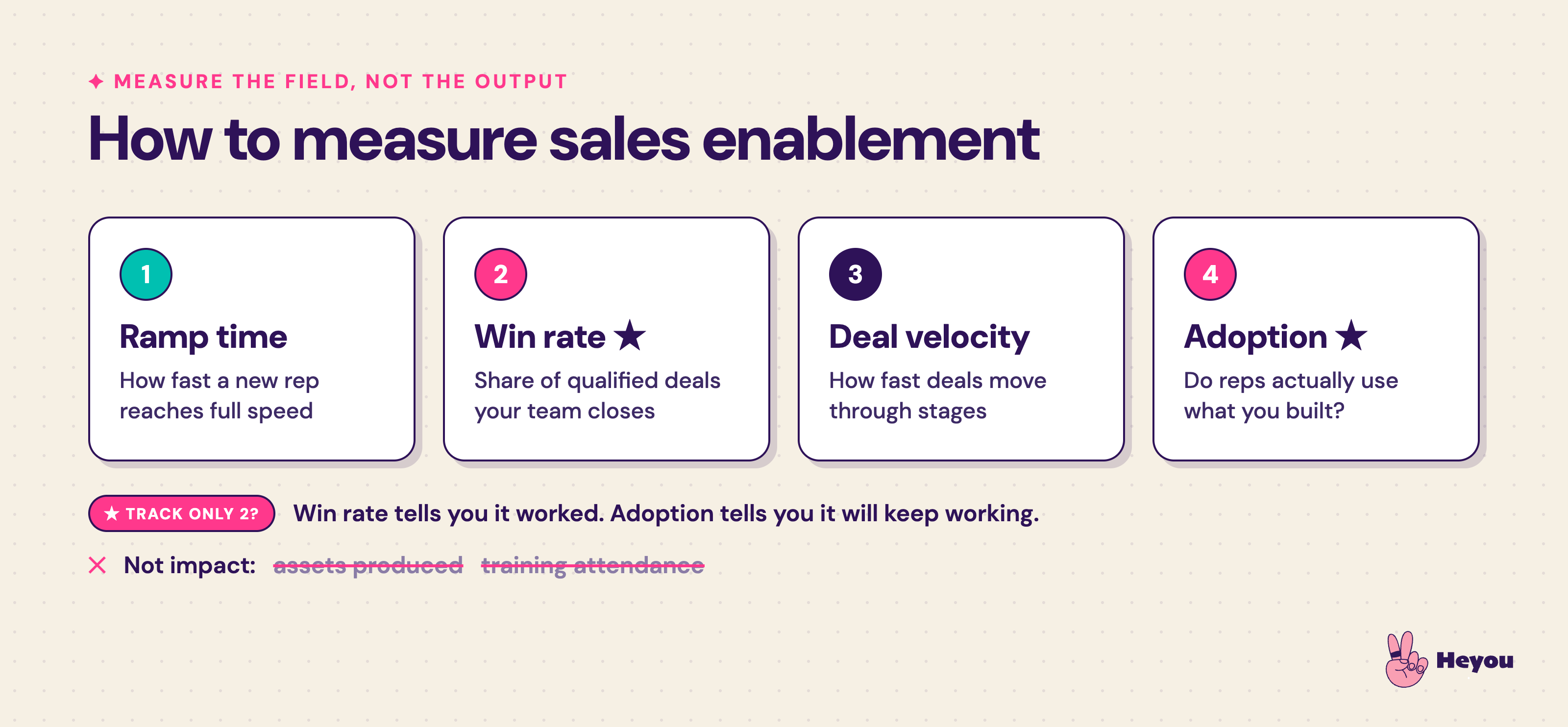
- Ramp time How long a new rep takes to reach full productivity. Shorter ramp is one of the clearest signs enablement is working.
- Win rate The share of qualified deals your team closes. This is the number enablement is ultimately paid to move.
- Deal velocity How quickly deals move through the stages. Better-prepared reps create cleaner, faster deals.
- Adoption Whether reps actually use the content, training, and moves you built. Low adoption is the loudest signal that you built for the shelf, not for the deal.
If you can only track two, track win rate and adoption. Win rate tells you whether it worked; adoption tells you whether it will keep working.
Related reading: the sales tools pillar, Sales Navigator vs Premium, the best AI SDR tools, and the GTM pillar.
← Back to the Sales Tools guide
What is sales enablement?
Sales enablement is the ongoing work of giving your sales team what it needs to win more deals: the training, the content, the coaching, and the time to actually sell. It is about helping each rep do a better job, not just buying another tool.
What is the difference between sales enablement and sales operations?
Sales enablement makes reps better at selling through training, content, and coaching. Sales operations makes the selling system run through process, data, territory design, and the tech stack. Enablement works on the person in the room; ops works on the machine around them.
What does a sales enablement team do?
A sales enablement team equips reps to sell: onboarding and ongoing training, building the content reps use in live deals, coaching on real calls, and protecting the team's time so more of it goes to selling. On a lean team one person often owns all of it.
What enablement content actually gets used?
The content reps reach for in a live deal: short, situation-specific assets like a one-page value summary, an objection answer, a relevant customer story, and a simple way to frame price. Long decks and dense wikis mostly go unused.
How do you measure sales enablement?
Measure it by what changes in the field: ramp time for new reps, win rate, deal velocity, and whether reps actually use what you built. Usage and win rate matter more than how many assets you produced or how many sat through a training.