Table of contents
TL;DR - Top performers do not sell harder, they help better. They listen more than they talk, dig for the real pain and put a number on it, get genuinely personal, and protect time to close. Selling is a craft you can learn, not a bag of tricks, and the data backs every one of these habits. This is the craft, one skill at a time.
Salespeople got a reputation for trapping people into buying. It is not entirely unfair, plenty earned it. But here is what the best ones know: you never need to trap anyone. When you know what you sell, why it matters, and who it is for, there are always more people who genuinely need it than people you would have to corner. You do not have to sell to everyone. You have to find the ones you can actually help.
I closed the first Heyou deal a week after we launched. Not because I ran a slick process, but because I know that pain in my bones, I have lived it, so when I sit with a buyer I am not running questions as a trap, I genuinely feel it with them. And people can tell the difference. That is the whole job.
Only about 3% of buyers say they fully trust salespeople (HubSpot / Salesforce). Almost nobody feels they get a real helper. Be the exception, and you are already ahead of the rest.
Selling skills are the learnable human abilities that turn a conversation into a deal: listening, uncovering real pain, getting personal, and closing without pressure.
What actually separates top performers?
Sellers who win act like a trusted advisor: they listen, they diagnose, and they only prescribe once they understand the problem. Sellers who lose act like a closer in a hurry. And 87% of buyers say the trusted-advisor version is exactly what they want (Salesforce).
It compounds, too. Among buyers who ranked a favorite before ever speaking to a seller, 84% went on to buy from the first vendor they talked to, against just 50% of buyers who had not (6sense, 2025 Buyer Experience Study).
Shut up and listen
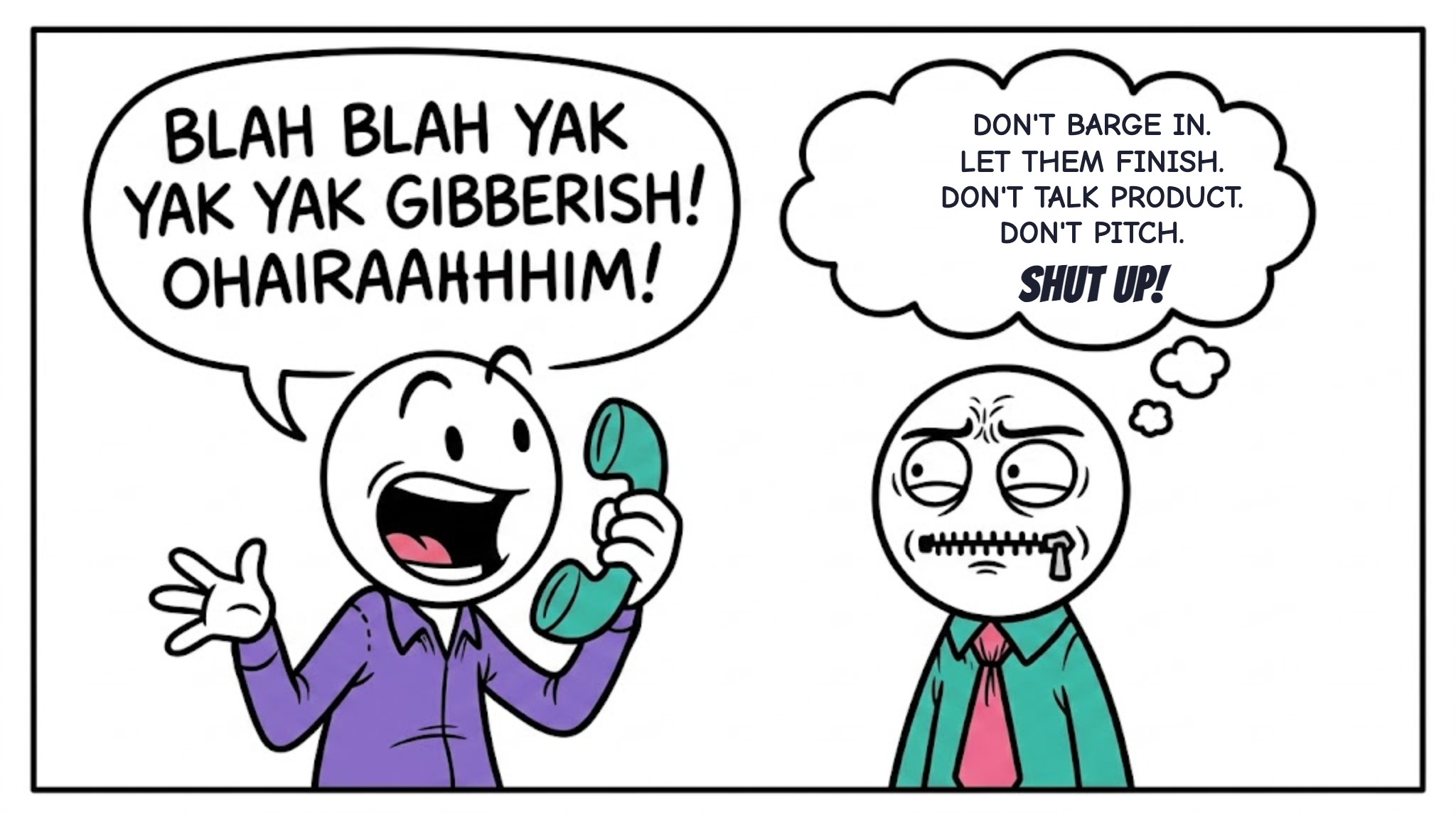
The single most reliable tell of a top performer is that they talk less. Gong analyzed 326,000 B2B sales calls and found the winners land near a 43:57 talk-to-listen ratio: they talk 43% of the time and listen 57%. Average reps talk 68% of the time, low performers 72%, and in deals that were lost, reps talked about 64% of the time (Gong).
I feel this one myself. When you have a product you love, it is genuinely hard to shut up about it. Every sentence the buyer says lights up three things you want to tell them. Resist it. The talking is not what closes. The listening is what tells you whether you can help at all, and what earns you the right to say anything.
Find the pain, and put a number on it
Listening on its own is not enough. You are listening for one thing: the real pain, not the surface complaint. Most buyers open with a tidy version of their problem. Your job is to gently move past it to the thing that actually keeps them up at night, and then to help them size it.
The cleanest tool for this is Sandler's pain funnel, a sequence of questions that goes deeper with each step (Pipedrive). Adapted, it runs roughly like this: tell me more about that; can you give me a specific example; how long has it been going on; what have you tried, and did it work; what is it costing you; and how do you feel about it.
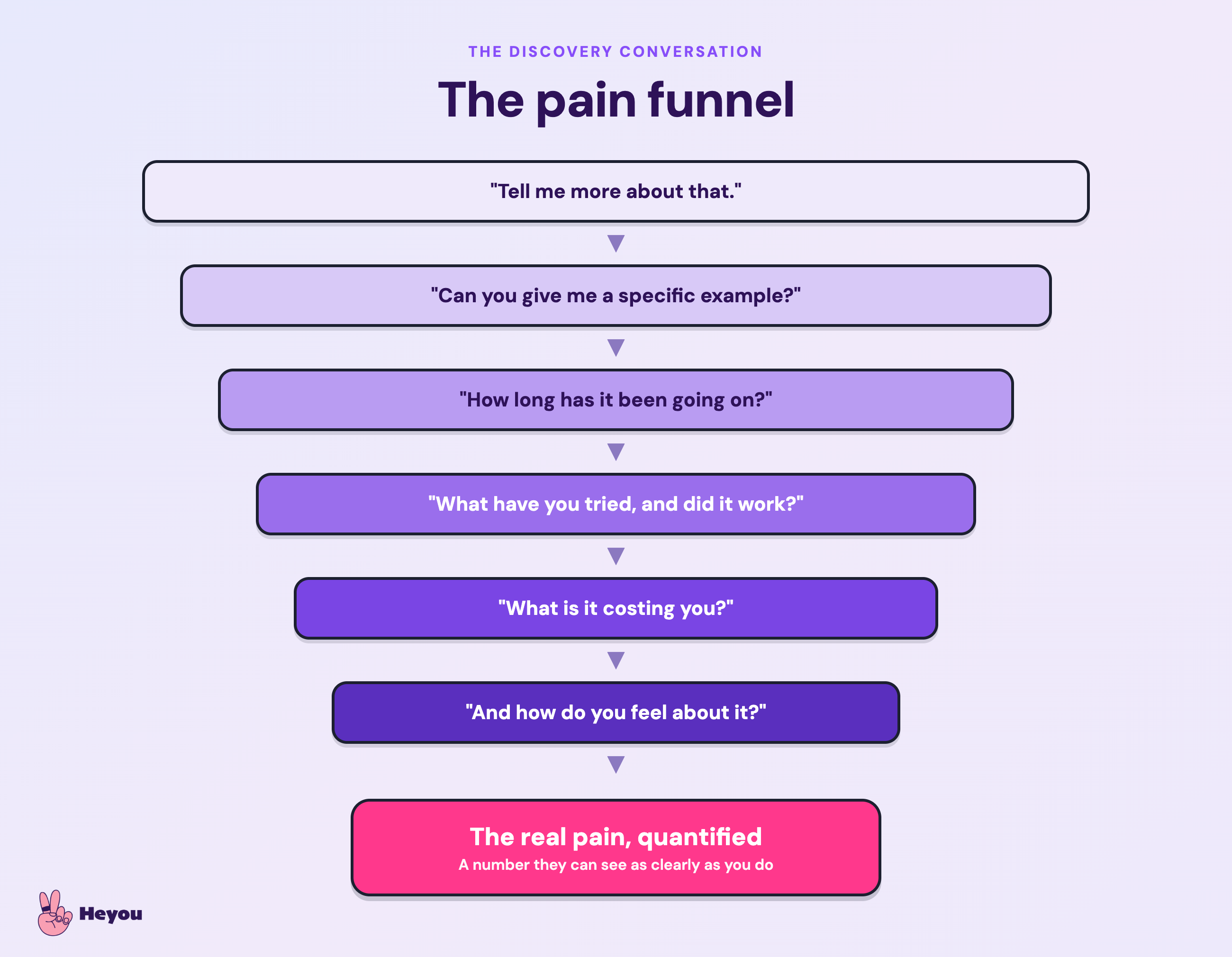
The questions here are adapted from the pain funnel, a discovery model created by Sandler.
Two things matter more than the script. First, this is not a trap. If you run it as a gotcha, buyers feel it instantly and close up. Run it because you actually want to understand. Second, put a number on the pain. "It is annoying" does not move a deal. "It is costing us two reps' worth of pipeline a quarter" does, because now the buyer can see the size of the problem as clearly as you can.
The art of getting personal
This is where the trusted advisor is made. When I sit with a buyer, I ask what they are using today, what about it frustrates them most, and why they have stuck with a tool that clearly is not working. I ask who feels the pain hardest, whether anyone has been let go because pipeline was not rising, and what the CRO privately thinks the real reason is. We almost always land on the same answer, and I feel it with them, because I have been in that seat.
That is the difference between a peer who has lived your problem and a rep reading a discovery script. People know the difference in seconds. Once they feel you genuinely understand, you are no longer a vendor, you are an advisor, and advisors get believed. It shows up in the numbers too: buyers are 89% more likely to buy from a seller who understands their goals (Salesforce).
Ask, don't pitch: the questions that do the work
Top performers do not pitch their way through a call, they ask their way through it. The discipline is simple and almost nobody does it: write everything down. Every pain, every phrase, every number the buyer gives you. Then, when it is your turn, you do not launch into features. You ask the one question that leads them to the conclusion you can already see.
Quantify the pain:
- "If nothing changes in the next six months, what happens?"
- "If you had a magic wand, what would this look like instead?"
- "So if I am hearing you right, the real issue is X, and it is costing you Y. Is that fair?"
That last one is the move: you reflect their own words back, quantified, and let them agree. They are now selling themselves, out loud, in their language, not yours. Most of this lives on the discovery call, so it is worth learning to nail the discovery call.
The close, and knowing when to say no
Closing is the most skipped skill on this list, and the most learnable. The mistake is running out of clock: a great conversation with no time left to agree on next steps closes nothing. Protect the last ten minutes of every call for it, on purpose.
When you get there, keep it clean and low pressure:
- "It sounds like this is a real priority. What would need to be true for us to move forward?"
- "What is the cost of doing nothing for another quarter?"
- "What would getting started look like on your side?"
And the underrated one: know how to say no. My honest mindset is that I am always trying to help, and if my product cannot genuinely help you, or you do not see this as a must-solve, I do not want you as a customer, no offense. Disqualifying the wrong buyer fast is not losing a deal. It is the most trusted-advisor thing you can do, and it frees you to spend the time on someone you can actually help.
The methodologies worth learning
You do not have to invent this craft. There are proven methodologies built to teach it, some free to read, some paid to train on. A few worth knowing, with our two cents:
Relationship-first, built around qualification and the pain funnel. Strong on not chasing bad-fit deals.
Neil Rackham's classic question framework: Situation, Problem, Implication, Need-payoff. Cheap and worth reading.
Dixon and Adamson: teach the buyer something new, tailor it, take control. Best in complex, crowded categories.
A qualification checklist for complex deals: Metrics, Economic buyer, Decision criteria and process, Identify pain, Champion.
Keenan's obsessive focus on the gap between the buyer's current and future state. Problem-centric to the core.
What separates top-performing salespeople from the rest?
They help instead of trap. In practice that shows up as measurable habits: they listen more than they talk, they dig for the real pain and put a number on it, they get genuinely personal, and they protect time to close. Gong found top performers talk 43% of the time and listen 57%, while average reps talk 68%. The skill is the conversation, not the pitch.
Can selling be learned, or is it natural talent?
It is learned. The best sellers are rarely the loudest people in the room. They got good at listening, preparing, asking better questions, and following up. Every skill on this page is a habit you can practice, and there are proven methodologies, from Sandler to SPIN to Challenger, built to teach them.
How much should a salesperson talk versus listen?
Less than you think. Gong's analysis of 326,000 B2B calls found top performers land near a 43:57 talk-to-listen ratio, while losing calls skew to about 64% talking. When your product is great it is hard to shut up about it, but listening is what closes.
What is the Sandler pain funnel?
It is a sequence of questions that moves a buyer from a vague, surface complaint down to the real problem, its history, what they have tried, and finally what it is costing them. The goal is not to trap anyone. It is to understand the pain well enough to know whether you can genuinely help, and to help the buyer see it clearly too.
When should you bring up your product on a sales call?
Late, and only once the pain is clear and the buyer has agreed on what solving it should look like. Most of the conversation should be about them. When you do connect your product, you connect it to the specific pain they described, not to a generic feature list.