

Table of contents
TL;DR
Account based marketing is a B2B approach that treats a defined list of named accounts as the market, rather than a broad pool of individual leads. You pick the accounts that matter, build a point of view for each, and coordinate marketing and sales around getting into those specific companies. ABM runs in three tiers (one-to-one, one-to-few, one-to-many) and works best when it sits on top of account based selling, not instead of it. The account list is the easy part. A real path into each account is the whole game.
What is account based marketing?
Account based marketing is the practice of choosing the accounts you want to win, then treating each one as a market of its own. Instead of casting a wide net and hoping the right buyers fall in, you name the companies, map the people who make the decision, and build everything around getting into those rooms.
The shift is simple to say and hard to do. Traditional demand capture optimizes for volume: more traffic, more leads, more form fills, then sales sorts through what comes back. ABM flips the order. You start from the short list of accounts that would actually move your number, and you work backward to the message, the channel, and the person who can open the door.
That is why ABM is a go-to-market decision, not a campaign type. It forces marketing and sales to agree on who matters before anyone spends a dollar, and it rewards depth over reach.
What is the difference between ABM vs demand generation and lead generation?
These three get mixed up constantly, so here is the clean version.
- Lead generation captures contact information from people who show interest. The unit of work is the lead, and the metric is volume.
- Demand generation educates a broad market so future buyers develop preference before they ever raise their hand. The unit of work is the audience, and the payoff compounds over months. If you want the full picture, start with B2B demand generation.
- Account based marketing concentrates on a named list of accounts you have decided to win. The unit of work is the account, and the metric is progress inside that list.
| Lead generation | Demand generation | Account based marketing | |
|---|---|---|---|
| Unit of work | The lead | The audience | The named account |
| Goal | Capture contact details | Build preference before anyone buys | Win the accounts you chose |
| Reach | Wide | Widest | Narrow and deep |
| Pays off | This quarter | Over months | Over the deal cycle |
| Measured by | Lead volume | Brand demand and pipeline over time | Progress inside the list |
They are not rivals. Demand generation widens the market and keeps your brand familiar to the 95% who are not buying yet. ABM takes the slice of that market you care about most and goes deep. The best teams run both: demand gen builds familiarity across the field, ABM wins the accounts that pay the bills.
One honest warning. ABM is not demand generation with a logo swapped into the banner. If your "ABM program" is really a broad campaign pointed at a slightly smaller list, you are doing demand gen and calling it ABM. The difference is personalization and sales coordination, not list size alone.
What are the tiers of ABM?
ABM scales through three tiers, and most programs run a mix of them at once.
- One-to-one. Deep personalization for a small set of strategic accounts, often fewer than 20. You research each company, tailor the message to its situation, and build custom moves for named people. This is expensive per account and reserved for the deals big enough to justify it.
- One-to-few. You group accounts that share a problem, an industry, or a trigger event, then personalize to the cluster rather than the individual company. It keeps most of the relevance of one-to-one at a fraction of the effort.
- One-to-many. Lighter personalization across a larger list, usually sorted by segment or industry. Technology does more of the work here, and relevance comes from fit rather than hand-built detail.
Pick the tier by the size of the prize. Put one-to-one effort behind the accounts that would change your year, one-to-few behind the clusters worth real attention, and one-to-many behind the broad list you still want to reach. Spreading one-to-one effort across hundreds of accounts is how ABM budgets disappear with nothing to show.
How do you pick the ABM account list?
The account list is where ABM is won or lost, and it deserves more rigor than a quick export of company names.
Start from fit. Define the ideal account the way you would define an ideal customer profile: industry, size, model, and the problems that make your value obvious. Then add the things that tell you an account is ready now, not someday. New leadership, a funding round, a compliance change, a hiring surge, or a shift in strategy all raise the odds that a buying window is open.
The step most teams skip is the honest one: can you actually get into this account? A perfect-fit company you have no way to reach is a wish, not a target. An account where you have a credible route in is worth three accounts where you do not. Rank your list by fit, by timing, and by reachability, and be willing to cut the names that only look good on a slide.
Keep the list small enough to mean something. A list of 500 "priority" accounts is not a priority. It is a mailing list.
Which ABM moves actually work?
Here is the part the tools will not tell you. The companies that win named accounts are not the ones with the biggest ad budget. They are the ones that find a real way in and make the buyer feel like a person, not a target on a list.
My first ABM program kicked off in 2018, and it was a disaster. We picked 100 target accounts, turned on some visibility tools, waited, and nothing happened. The lesson was expensive and clear: ABM cannot live without account based selling behind it. If sales and marketing do not talk, if no one owns the actual conversations inside each account, you get exactly that kind of silence. ABM is the marketing half of a two-person job.
The best idea I ever saw came later. A company sent every team that started an evaluation a giant package to their office: branded snacks, stickers for the whole team, hoodies, with a simple note that said "thank you for being our friends." It worked because it made people feel like they had won. That is the real mechanic under good ABM. You are not interrupting an account. You are giving the people inside it a reason to want you there.
So the moves that work share a shape. They lead with something useful or human before they ask for anything. They are built for a specific account, not resized from a generic template. And they always have a path behind them, a reason this message reaches this person and lands instead of bouncing.
This is where most ABM programs stall. Teams spend weeks perfecting the list and the creative, then have no better way into the account than everyone else does. Heyou works on that exact gap. It uncovers the hidden paths into your named accounts, the ones you cannot see on your own, and turns intros and referrals into a repeatable channel instead of a lucky accident. You still choose the accounts. Heyou helps you get in.
How do you measure ABM honestly?
ABM breaks most marketing dashboards, because those dashboards count leads and ABM is not a lead game. Measure account progress instead.
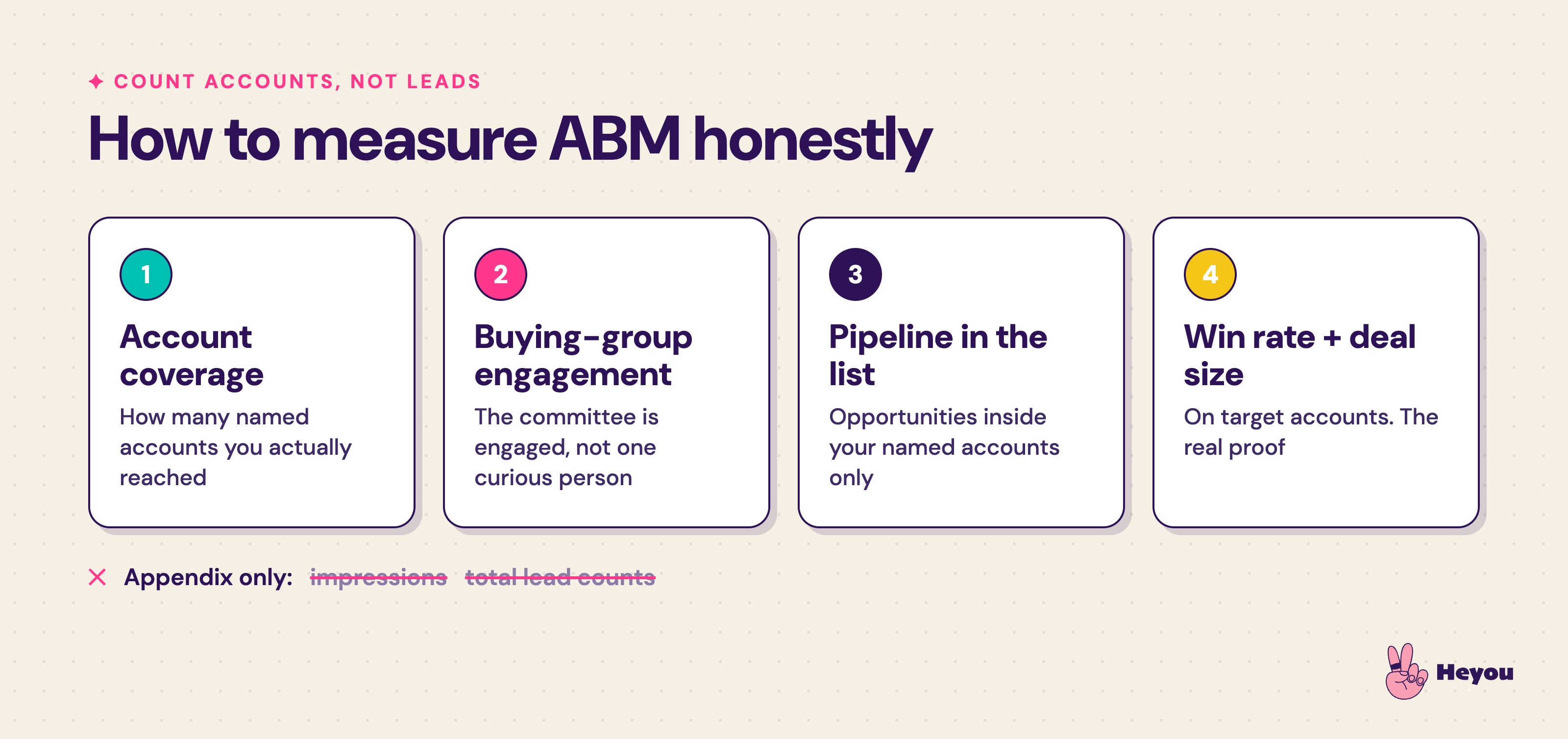
- Account coverage. How many of your named accounts have you actually reached, and how many buying-group members inside each one are engaged?
- Account engagement. Is the right committee interacting, not just a single curious person? Depth inside an account matters more than a spike from one contact.
- Pipeline created in the list. Opportunities sourced or influenced inside the named accounts, not pipeline in general.
- Win rate and deal size on target accounts. The real proof. ABM should raise both, because you are concentrating effort where you are most likely to win.
Impressions and total lead counts belong in the appendix, if anywhere. They tell you the campaign ran. They do not tell you whether you got into the accounts that matter.
Where does ABM fail?
ABM fails in two predictable ways, and both are avoidable.
The first is targeting accounts you have no way to reach. A list of dream logos with no route in produces beautiful reports and no pipeline. Reachability is a selection criterion, not an afterthought, and it is the one most teams leave out.
The second is ABM with no account based selling behind it. When marketing runs an account campaign and sales is not in the room building the actual relationships, you get the 2018 silence I described earlier. ABM is the air support. Sales is the ground game. Neither wins the account alone.
Avoid both and ABM earns its reputation. Skip either and it becomes an expensive way to send ads to a shorter list.
Keep going: start with the demand generation pillar for the full market view, then see how ABM connects to pipeline generation, the sales funnel, and your wider go-to-market strategy.
← Back to the Demand Generation guide
What is account based marketing?
Account based marketing (ABM) is a B2B approach that treats a defined list of named accounts as the market, instead of a broad audience of individual leads. Marketing and sales pick the accounts that matter, build a point of view for each one, and coordinate every touch around getting into those specific companies and their buying groups.
What is the difference between ABM and demand generation?
Demand generation educates a broad market so future buyers come to you over time. ABM narrows that focus to a named list and works to get into those exact accounts now. Demand gen widens the top of the funnel; ABM goes deep on a short list. Most strong programs run both, with demand gen building awareness across the market and ABM concentrating effort on the accounts worth winning.
What are the tiers of ABM?
ABM usually runs in three tiers. One-to-one is deep personalization for a handful of strategic accounts. One-to-few groups a cluster of similar accounts and personalizes to the cluster. One-to-many uses lighter personalization across a larger list, often by industry or segment. Most teams blend the tiers, putting the most effort where the revenue is largest.
Does ABM actually work?
ABM works when you have a real path into the accounts you target and when sales and marketing act as one team. It fails when it is treated as an ad campaign pointed at a list, with no account based selling behind it. The account list is the easy part; getting into those accounts is the whole game.
How do you measure ABM?
Measure ABM on account progress, not lead volume. Track how many target accounts you have reached, how engaged each buying group is, pipeline created inside the named list, win rate on those accounts, and deal size. Vanity metrics like total impressions or raw lead counts tell you almost nothing about whether you are getting into the accounts that matter.