
Table of contents
TL;DR
A sales funnel is the stage-by-stage view of how buyers move from first hearing about you to becoming customers. It differs from a pipeline: the funnel is a volume view of your whole market, the pipeline is a deal view of the opportunities a rep is working now. A healthy B2B sales funnel has a well-fit top, a trust-building middle, and a fast, human bottom. Most funnels leak for two reasons, a wrong-fit top and a no-trust middle, and the fix is rarely more volume. The biggest shift in modern selling is flipping the funnel: instead of pouring strangers in the top and hoping a few survive, you start from real relationships, intros, and referrals, and work outward from there.
What is a sales funnel, and how is it different from a pipeline?
A sales funnel is a model of how interest narrows into revenue. A large number of people become aware of you, a smaller number get interested, fewer still evaluate, and a few buy. Drawn out, that shape looks like a funnel, which is where the name comes from.
The word people most often confuse it with is pipeline, so it is worth being precise. A funnel is a volume view. It answers questions about your market: how many buyers are entering at the top, how many make it from one stage to the next, and where the drop-offs are. A pipeline is a deal view. It answers questions about your quarter: which named opportunities are open right now, what they are worth, and when they are likely to close.
You need both, and they measure different things. The funnel tells you whether your demand is healthy. The pipeline tells you whether your forecast is. A business can have a full pipeline this quarter and a broken funnel that will starve it next quarter, which is exactly why looking at only one of them is dangerous.
What are the stages of a B2B sales funnel?
Different teams draw the funnel with different numbers of stages, but the logic is always the same, and every stage has exactly one job: move a qualified buyer to the next stage. If a stage is not doing that, it is decoration.
A practical B2B funnel looks like this:
- Awareness. The buyer learns that a problem, and your category, exists. The one job here is to be found and understood by the right people, not by everyone.
- Interest. The buyer starts paying attention and wants to learn more. The one job is to teach something useful, so attention turns into genuine curiosity.
- Consideration. The buyer is comparing approaches and vendors. The one job is to make it easy to see why you fit their specific situation.
- Intent. The buyer signals they are seriously evaluating: a demo request, a pricing question, a reply that moves the conversation forward. The one job is to respond fast and make the next step obvious.
- Evaluation. The buying group is deciding. The one job is to arm your champion so they can win the room when you are not in it.
- Purchase. The deal closes. The one job is to remove friction, not to add a final hurdle.
Marketing usually owns the top, sales owns the bottom, and the handoff in the middle is where most good deals quietly die. The stages are not the point. The one job of each stage is.
Which metric matters at each stage, and which are vanity?
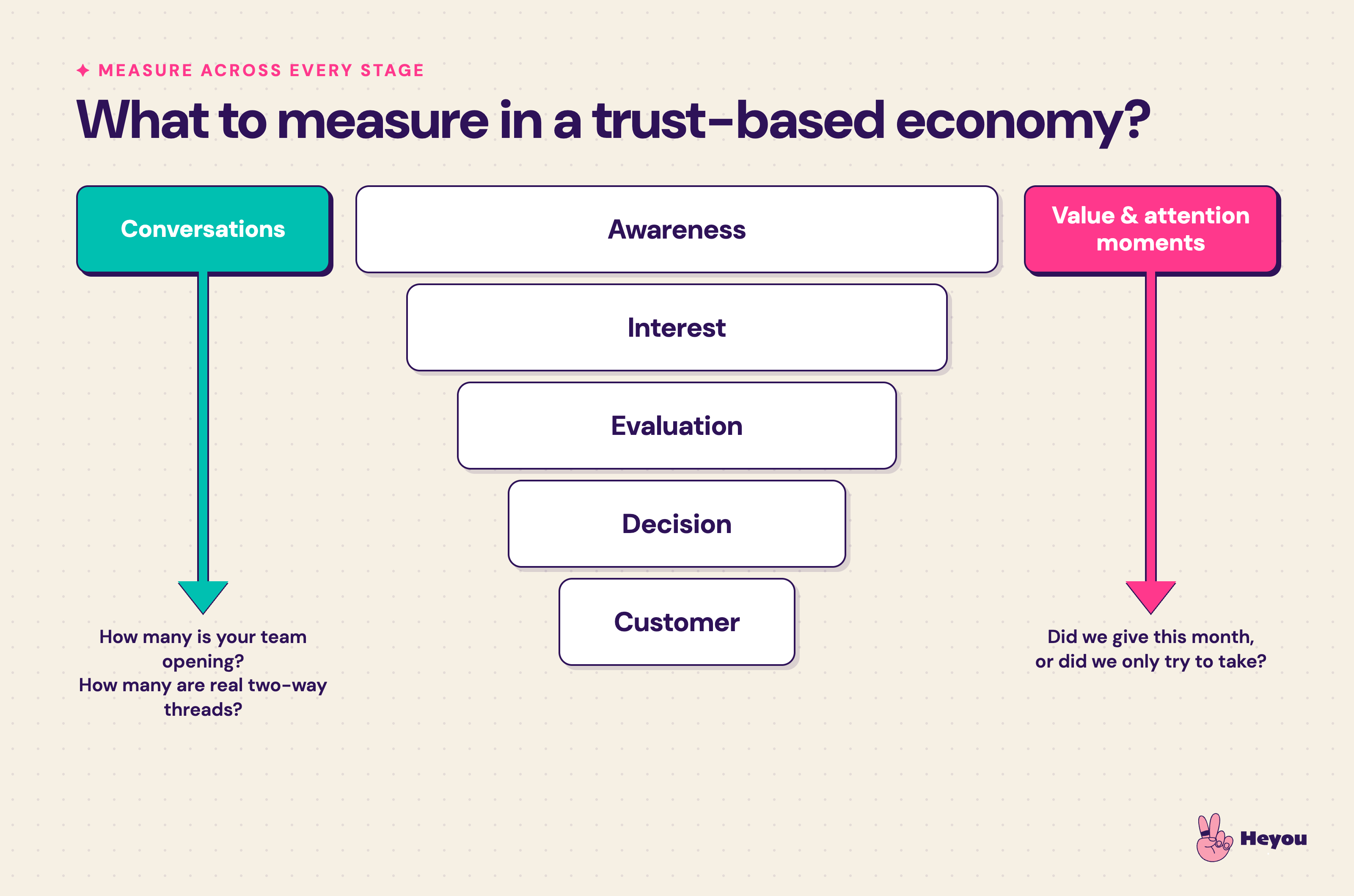
The mistake most teams make is measuring everything and acting on nothing. Each stage has one metric that actually tells you if its one job is getting done, and a cloud of vanity metrics that feel productive to report.
| Stage | The metric that matters | The vanity version |
|---|---|---|
| Awareness | Reach into the right audience | Raw impressions |
| Interest | Real attention: repeat visits, genuine replies | A spike in likes |
| Consideration | Conversion into a real conversation | Downloads and form fills |
| Intent | Speed and response rate | Demo requests nobody follows up on |
| Evaluation | Win rate inside qualified deals | Total open opportunities |
| Purchase | Cycle time and close rate on committed deals | Forecast optimism |
A million views from the wrong people will never convert. And in B2B, the first responsive vendor often beats the best one.
The one metric that runs through every stage is conversations. That means real two-way threads with the right people, so replies and calls made don't count. It is the rare number that tracks 3 things at once: whether buyers are engaging, whether trust is being built, and whether a real relationship is forming. If conversations go up at the stage that matters to you, everything below it usually follows.
For skimmers: measure the conversion rate between each pair of stages and watch the trend. That is what tells you where the funnel is really breaking. Totals at the top feel good and teach you nothing.
Why do sales funnels leak, and where?
Funnels almost never leak evenly, and the leaks come from 2 causes: fit and trust. Both of them break at the top of the funnel and in the middle.
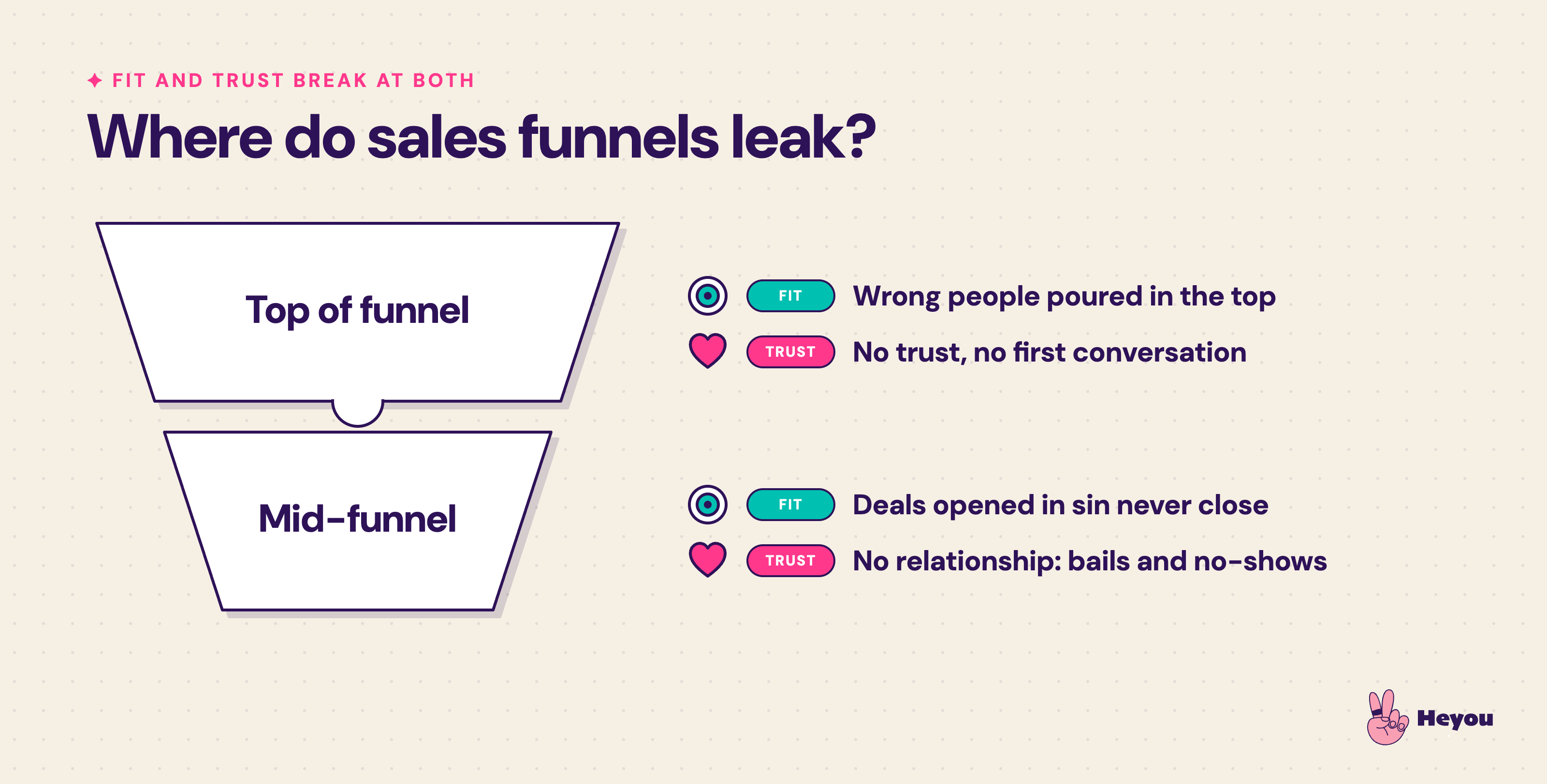
Fit breaks twice. At the top, it looks like pouring in buyers who were never going to qualify. More volume makes this worse, not better, because you are asking later stages to convert people who do not belong there. In the middle, it shows up as deals that were opened in sin: opportunities created to hit a number, with the wrong account or the wrong person, that were never going to close. They sit in the pipeline and burn your reps' time on the way out.
Trust breaks twice too. At the top, a buyer who does not trust you simply does not start a conversation. In a market where buyers do most of their research before they ever talk to you, a cold message from a stranger is easy to ignore. In the middle, a buyer who does not feel committed to you, and has no relationship with you, bails on the next step, delays, or no-shows the meeting. Nothing in the process earned their confidence, so leaving costs them nothing.
Fixing a leak means fixing fit and trust at both stages. Adding more strangers at the top is the most common response and the least effective one.
I built my first funnel plan 12 years ago. It didn't look that different from what we draw today. What changed dramatically is the conversion rate from one stage to the next. The top of the funnel was always tricky, but with a little persistence and creativity you'd do well enough. Back then a cold email could get a 30-40% response rate. Can you imagine that today? The world changed, and every stage of the funnel got deeper and harder. The picture stayed the same. The physics underneath it did not.
Funnel vs flywheel vs the flipped funnel
Once you accept that the cold top of the funnel keeps getting more expensive and less productive, the natural question is whether the shape itself is wrong. Three models are worth knowing.
The classic funnel moves in one direction: strangers in the top, customers out the bottom, and the relationship more or less ends at the sale. It treats data as the starting point and people as the output, you buy a list, you work the list, you hope.
The flywheel fixes part of this by refusing to let the relationship end at purchase. Happy customers create referrals and advocacy that feed the top again, so momentum compounds instead of resetting with every quarter. It is a better model because it values what happens after the sale.
The flipped funnel goes further and changes where you start. Instead of beginning with data and pushing toward people, it begins with people and works outward to data. You start from real relationships, the intros and referrals and genuine conversations you can actually earn, and you build the rest of the demand around them. The point is not that cold never works. It is that relationships convert at a rate cold cannot touch, so building your funnel on top of them changes the economics of every stage below. Intros and referrals stop being a lucky accident and become a channel you can run on purpose, and the hidden paths into your target accounts, the ones a single person can't see alone, become something you can actually find and use.
How does AI change the sales funnel?
The useful way to think about AI in the funnel is by altitude. The top of the funnel is where repetitive, high-volume work lives: research, enrichment, summarizing, keeping records clean, noticing signals across more accounts than a human could watch. That work is a good fit to automate, and automating it frees your team to spend time where time actually matters.
The bottom of the funnel is the opposite. Discovery, earning trust, reading a room, handling the real objection behind the stated one, negotiating, closing, these stay human because they are about one person understanding another. The risk is not that AI is too weak here. The risk is automating the exact moments that were supposed to build the relationship, and sending buyers a flood of generic touches that feel like the spray they already resent.
So the honest model is simple: let the work clear the busywork at the top, and protect the human moments at the bottom. The funnel does not get shorter. It gets cleaner, so your people spend their hours on the stages where a human is the entire point.
How to diagnose your own sales funnel this week
You do not need a new tool to find out where your funnel is broken. You need one honest hour.
- Draw your real stages, not the ideal ones. Write down how a buyer actually moves from first contact to closed deal in your business.
- Put a number on each join. For each pair of stages, roughly what percentage move forward? You are looking for the one join where the number falls off a cliff.
- Name the leak. Is the biggest drop at the top, which points to a fit problem, or in the middle, which points to a trust problem?
- Check your top for fit before volume. Look at the buyers entering at the top. Were they ever going to qualify? If a large share were not, your problem is sourcing, not selling.
- Check your best-converting source. Look at where your actual closed deals came from. If intros, referrals, and genuine relationships punch far above their volume, that is your signal to build the funnel outward from them instead of pouring in more cold at the top.
Do that once and you will usually find that the fix is not a bigger top. It is a better-fit top, a more useful middle, and a motion that starts from the relationships that already convert.
Keep going: start with the demand generation guide for the pillar overview, then read B2B demand generation, pipeline generation, account based marketing, and the go-to-market strategy guide.
← Back to the Demand Generation guide
What is the difference between a sales funnel and a pipeline?
A sales funnel is a volume view of how many buyers move from awareness to purchase, stage by stage. A pipeline is a deal view of the specific opportunities a rep is working right now, with amounts and close dates. The funnel tells you about the health of your demand, the pipeline tells you about the health of your quarter.
What are the stages of a B2B sales funnel?
A practical B2B funnel runs through awareness, interest, consideration, intent, evaluation, and purchase. Marketing usually owns the top, sales owns the bottom, and the handoff in the middle is where most deals are won or lost. Each stage has one job: move a qualified buyer to the next one.
What is a good sales funnel conversion rate?
There is no single number that fits every business, because it depends on your motion, your deal size, and how you source demand at the top. The useful benchmark is your own trend: measure the conversion rate between each pair of stages, watch it over time, and compare channels against each other rather than against an industry average that was not built for your funnel.
Why do sales funnels leak?
Funnels leak for 2 reasons, fit and trust, and both break at the top and in the middle. At the top, the wrong people come in and buyers who do not trust you never start a conversation. In the middle, deals opened with the wrong account never close, and buyers with no relationship to you bail or no-show. Fixing the leak means fixing fit and trust at both stages, not adding more volume at the top.
Is the sales funnel outdated?
The funnel is still a useful way to measure and diagnose demand. What is outdated is treating it as a one-way chute you pour strangers into. Buyers move in loops, not straight lines, and the strongest motion starts from real relationships and works outward instead of starting from cold volume.