

Table of contents
TL;DR
A GTM plan is your go-to-market strategy turned into steps: which markets and segments you focus on, who the buyer is, which motion sells to them, and which channels get you in the door. It is not a marketing strategy. Marketing is what you say; GTM is how you get in the room to say it. A strong GTM plan moves in order, from a sharp ICP, to the problem you solve, to the buying group, to the motion, to the channel mix, to the actions that turn signals into next moves, and it is measured by whether it gets you into accounts you can actually win, not by how many leads land in the top of a funnel.
What is a GTM plan?
A go-to-market strategy is how a company reaches a market and converts it into revenue (the GTM pillar covers the big picture). A GTM plan is that strategy built out into decisions your team can act on. It decides which markets you go after, which segments inside them, who you sell to, how you sell, and where you show up to do it. Everything downstream, the campaigns, the sequences, the content, is an expression of those few decisions.
The trap is treating GTM as a bigger word for marketing. They are not the same thing, and mixing them up is where a lot of plans fall apart. GTM is about how I penetrate a market: which markets I focus on, which segments, which channel mix gets me in. Marketing is about what I am going to say: the messaging, the branding, what each persona wants to achieve, and how I break that into personas and segments. One is the way in. The other is the words. You need both, but you cannot substitute one for the other, and a beautiful message aimed at a market you have no way to enter is just an expensive opinion.
A useful GTM framework holds a simple order. Who is the buyer, what problem do they have that is worth paying to solve, how do they buy, where do they already pay attention, and what is the move that gets you from a signal to a real conversation. Get those right and the rest is execution. Get them wrong and no amount of content fixes it.
GTM strategy vs marketing strategy: what is the real difference?
Here is the cleanest way to hold the two apart.
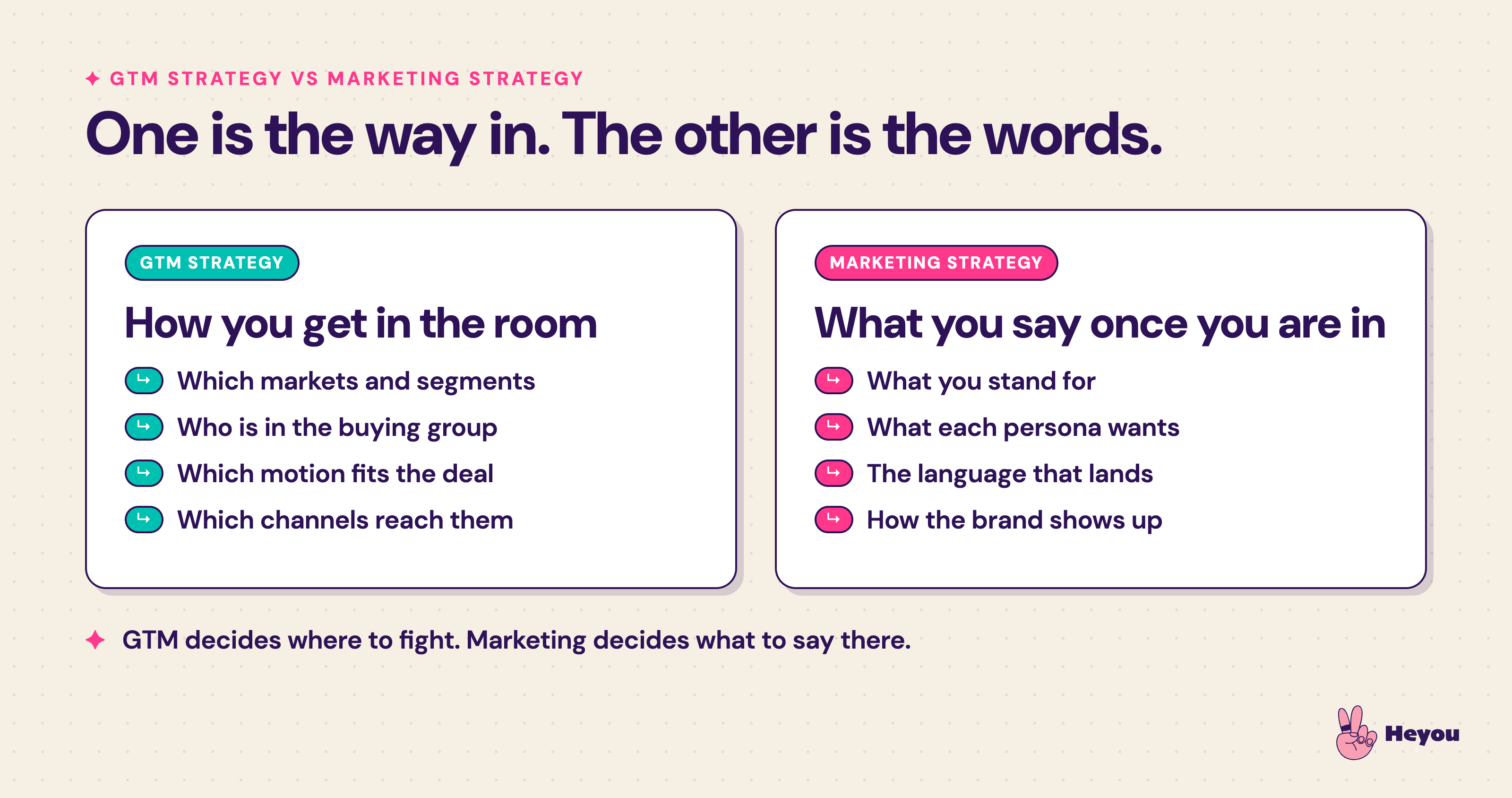
Your GTM strategy answers questions about reach and entry:
- Which markets and segments are worth your time this quarter and this year.
- Who sits in the buying group, and who actually signs.
- Which motion fits the deal size and the way these buyers decide.
- Which channels put you in front of them without being ignored.
Your marketing strategy answers questions about meaning and message:
- What you stand for, and how you want the category to think about the problem.
- What each persona is trying to achieve, and the language that lands with them.
- How the brand looks, sounds, and shows up across every touch.
GTM decides where to fight. Marketing decides what to say when you get there. A team that confuses the two tends to pour energy into messaging while quietly ignoring the harder question of whether it can reach the accounts on its list at all.
What are the core inputs of a GTM plan?
Before you pick a motion or a channel, 3 inputs have to be real, not aspirational. Think of them as a triangle: take away any one corner and the strategy falls over.
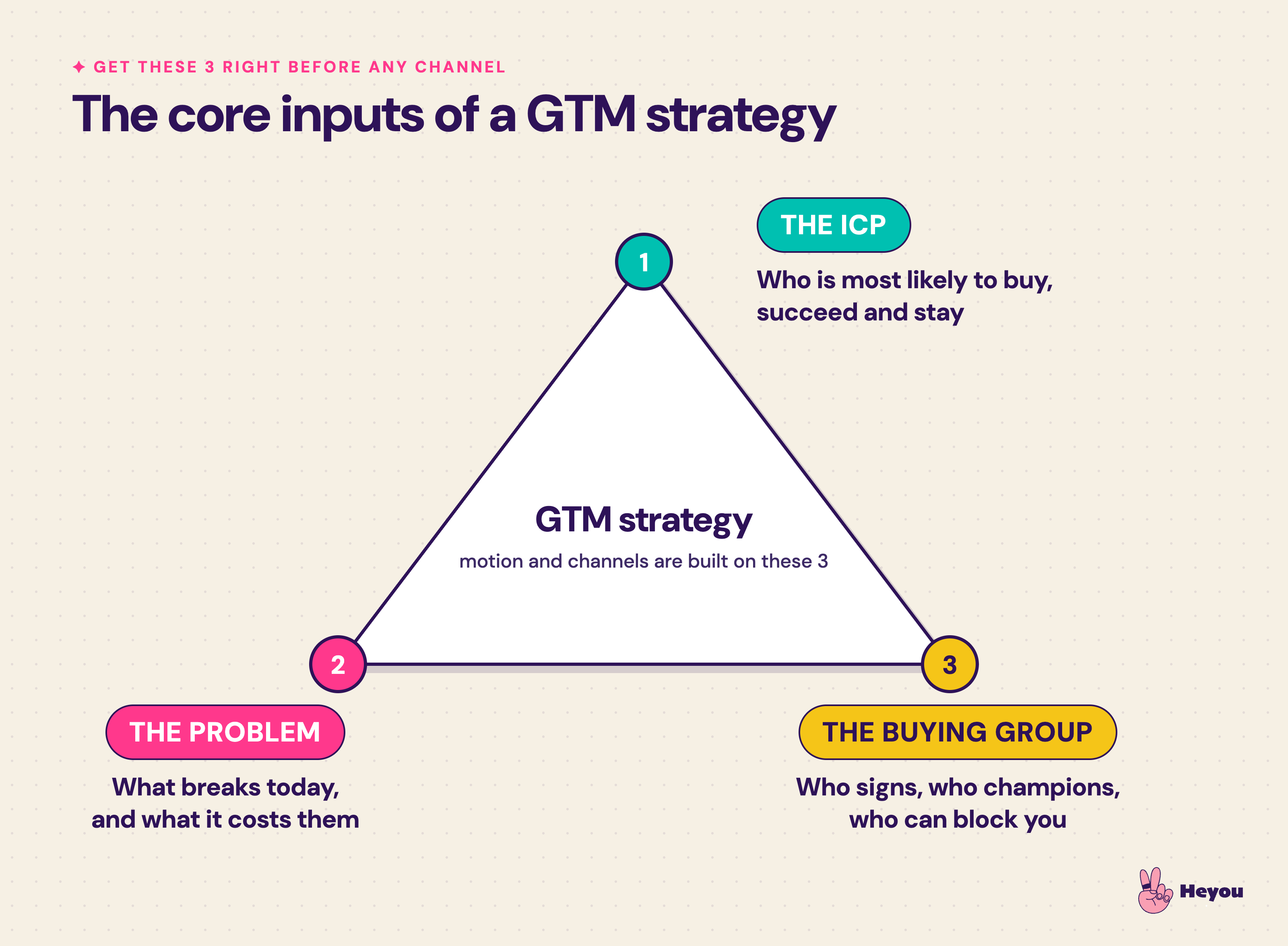
The ideal customer profile (ICP)
The ICP is the shortlist of accounts most likely to buy, succeed, and stay. It is built from firmographics like industry, size, and geography, and from the signals that show the problem is live: a new leader, a funding round, a hiring pattern, a compliance deadline. A loose ICP spreads a small team across too many bets. A sharp one concentrates effort where it converts. If everyone is a target, no one is.
The problem you solve
A GTM strategy stands on a problem a buyer will pay to make go away. Not a feature, not a category, a problem with a cost attached. If you cannot say what breaks for the buyer today and what it costs them to leave it broken, the rest of the plan has nothing to push against.
The buying group
In B2B, almost no one buys alone. There is an economic buyer who owns the budget, a champion who sells for you internally, technical evaluators who can block you, and users who live with the result. Your GTM strategy has to account for all of them, because a deal dies on the one stakeholder you ignored. Mapping the buying group early tells you who you actually need to reach, which shapes both the motion and the channels.
How do you choose a GTM motion?
A GTM motion is the repeatable way you acquire and convert customers. The main ones:
- Sales-led. A human moves the deal through discovery, evaluation, and close. Fits larger deals, complex buying groups, and products that need explaining.
- Product-led. The product itself drives adoption through a free tier or trial, and buying follows use. Fits lower-priced, self-serve products with fast time to value.
- Marketing-led. Content, demand, and brand create inbound interest that converts with light sales touch. Fits categories where buyers research hard before they ever raise a hand.
- Partner or channel-led. Someone else's trust and distribution carries you in. Fits markets where a trusted third party already owns the relationship.
Most companies do not pick one. They run a primary motion and layer others by segment: product-led for small accounts, sales-led for enterprise, partner-led for a region where you have no presence. The decision is driven by deal size, how complex the purchase is, and how your buyers actually prefer to decide. A motion that fights your buyer's natural behavior burns cash and stalls.
How do you choose the channel mix?
Honestly, there is no formula for this one. The right channel mix depends on your buyer, your motion, your deal size and your budget, and what works brilliantly for one company can burn money for the one next door. Some teams see paid social perform well right now, and you cannot argue with results that are in front of you.
What does hold everywhere is the starting point: a tight ICP tells you where your buyers already spend their attention and whose word they trust. Test a few channels against that, measure them against each other, and keep what works for you. Whatever mix you land on, one channel deserves a place in it: people vouching for you to people they know. An intro or a referral arrives with trust already attached, which no cold channel can manufacture.
Heyou turns intros and referrals into a repeatable channel, and uncovers the hidden paths into your target accounts that are hard to see without an AI army working the connections for you. It does not surface a relationship you already had on file. It creates a way in, so the accounts on your ICP list stop being names you admire from a distance and start being conversations.
What is the actions layer, and why does it decide everything?
Most GTM strategies stop at the plan: here is the ICP, here is the motion, here are the channels. Then the signals start arriving, a pricing page visit, a champion changing jobs, an account that just raised money, and nothing happens, because no one decided what to do with them.
The actions layer is the part that turns a signal into a move. A good GTM strategy does not just hand you a dashboard of intent. It hands you the next action: who to reach, through which path, with what reason to talk now. This is the difference between a strategy that looks right in a deck and one that produces pipeline. GTM, done well, is a machine that moves from signal to action, over and over, without the signal going cold while someone figures out what it means.
A small team lives or dies on this layer, because it has no spare hours to turn raw data into decisions by hand. The strategy has to shorten the distance between knowing something and doing something about it.
Which GTM metrics actually matter?
A GTM strategy generates a lot of numbers, and most of them are noise. The few that matter tell you whether you are getting into accounts you can win and turning them into revenue.
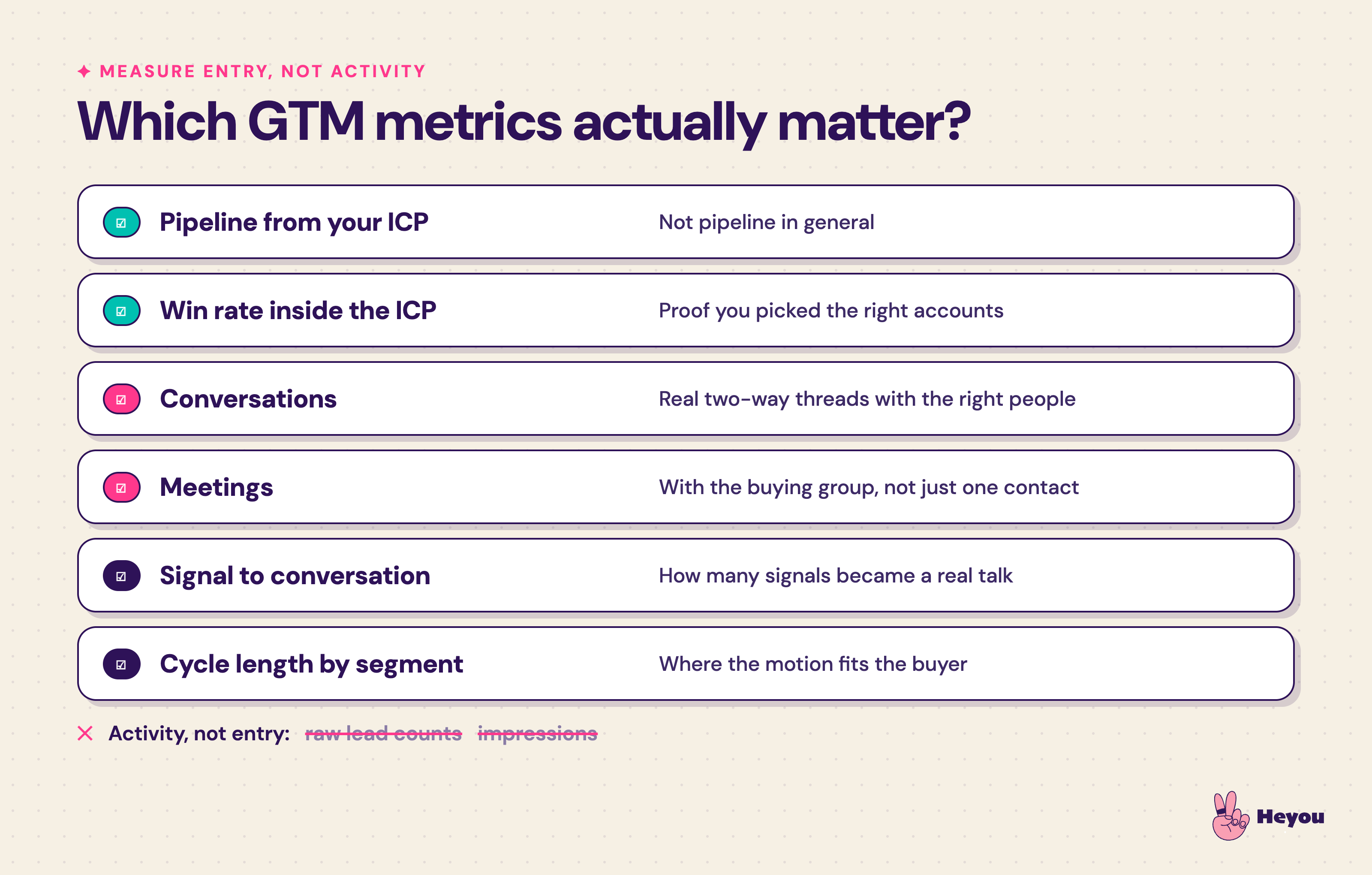
- Pipeline sourced from your ICP, not pipeline in general. Volume from the wrong accounts is a vanity number that flatters the top of the funnel and disappoints the bottom.
- Win rate inside the ICP. If you are winning the accounts you said were the right ones, the strategy is working. If you are only winning outside it, the ICP is wrong.
- Conversations. Real two-way threads with the people in your target accounts. This is the earliest honest sign that you are getting in, and it tracks engagement and trust in one number.
- Meetings. Held meetings with the buying group, not booked ones and not a single friendly contact. A meeting is the moment a target account becomes a real opportunity.
- Conversion from signal to conversation. This measures the actions layer directly: of the signals you saw, how many became a real talk.
- Sales cycle length by segment, which tells you where the motion fits the buyer and where it fights them.
Notice what is missing: raw lead counts and impression numbers. Those measure activity, not entry. The job of a GTM strategy is to get you into the right rooms and win them, so measure that.
A simple way to pressure-test your GTM plan this week
Take your current account list and ask one question of each name: what is the actual path in. Not the message you would send, the path. If the honest answer for most of the list is a cold channel you already know gets ignored, the problem is not your messaging and it is not your product. It is that your strategy has targets with no way to reach them, which is the most common and most expensive way a go-to-market plan quietly fails.
Fix that, and everything else in the plan starts to pay off.
Keep going: the GTM pillar frames the whole function, and these go deeper on the parts above: GTM engineering, sales influencers, and the full picture of demand generation.
What is a GTM plan?
A GTM plan is your go-to-market strategy turned into decisions you can act on: who the ideal customer is, the problem you solve, the buying group, the motion that sells to them, the channel mix that reaches them, and the metrics that show it is working. It answers how you get into the room, not what you say once you are there.
What is the difference between a GTM strategy and a marketing strategy?
A GTM strategy is the way in: which markets, which segments, and which channel mix gets you to the buyer. A marketing strategy is the words: the messaging, the branding, and what each persona wants to achieve. GTM decides where to fight. Marketing decides what to say when you get there.
What are the steps to build a GTM plan?
Define the ICP and the problem you solve, map the buying group, choose the motion that fits the deal and the buyer, pick the channel mix that reaches them, build the actions layer that turns signals into next moves, then track the few metrics that show whether you are getting into real accounts.
What is a GTM motion?
A GTM motion is the repeatable way you acquire and convert customers: sales-led, product-led, marketing-led, or a mix. The right motion depends on deal size, buyer behavior, and how complex the purchase is. Most B2B companies run more than one at once for different segments.
Why do go-to-market strategies fail?
Most fail because they are a messaging exercise dressed up as a strategy, or because the plan targets accounts the team has no way to reach. A clear ICP and a sharp message do nothing if there is no path into the accounts on the list.