

Table of contents
TL;DR - A discovery call is your first real conversation with a prospect, run to learn their problem and whether the two of you can genuinely help each other. Treat it as an honest exploration, not a pitch. "No fit" is a legitimate outcome. Uncover the pain, a compelling event, the timeline, and the decision-maker, then protect time at the end to close on one specific next step. Strong predictors of whether it goes anywhere or not are how the conversation started: trust-sourced calls progress far more than cold ones.
A discovery call is a mutual exploration of whether you can help each other, not a pitch and not a qualification form.
A few years ago I met a developer at a conference in London. Everyone around us was pitching. I did not. I asked what he was working on, what was frustrating him, what he wished worked better. We talked for twenty minutes about his problems, not my product. By the end, he had worked out for himself where something like what I do could help. That conversation turned into one of the biggest deals of the year. You are not there to convince. You are there to understand so well that the value, or the lack of it, becomes obvious to both of you.
And this matters more now, not less. AI has taken over the data work of selling: the research, the list-building, the drafting, the scoring. The one thing it cannot do is sit in a real conversation, read the room, and earn trust. That makes the discovery call the skill that actually sets you apart.
What is a discovery call?
A discovery call is the first substantive conversation between a seller and a prospect. Its job is to learn what is going on in their world, what problem they are trying to solve, what it costs them, and whether you are the right person to help.
It is not a few things people confuse it with:
- A discovery call is not a demo. You cannot show the right thing until you know what matters to them.
- A discovery call is not a pitch. Talking about you before you understand them is guessing out loud.
- A discovery call is not a qualification interrogation. A list of questions fired one after another makes the prospect feel processed, not understood.
How long should a discovery call take?
There is no fixed length, and building the call around a clock is the fastest way to turn it into an interrogation. What matters is the shape, not the minutes. You are here to help, and to learn enough to see whether you can help at all. Put that honesty on the table early: "No fit" is a legitimate outcome, and saying so up front is what makes the whole thing feel like an exploration rather than a pitch. You are not selling. You are working out whether the two of you can help each other.
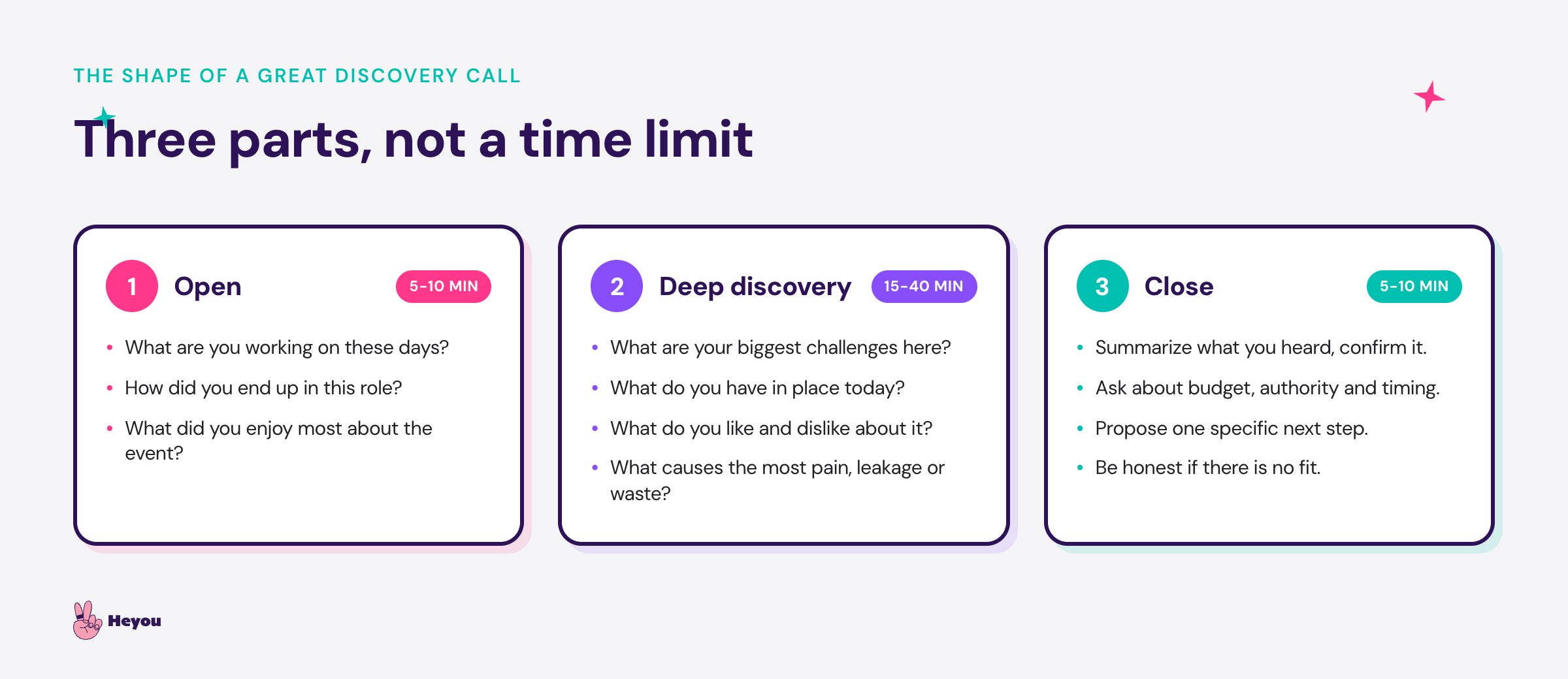
A good call has three parts.
1. Open (roughly 5 to 10 minutes): be human first. Start personal and friendly, not technical. You are earning the right to the real conversation. If you have a reference for how you met, start there. If you met at an event, ask what they liked most about it. Otherwise, keep it simple:
- What are you working on these days?
- How did you end up in this role?
2. Deep discovery (roughly 15 to 40 minutes, depending on your solution): understand the problem. Now go deep on the topic. This is where you learn whether there is a real pain you can actually solve.
- What are your biggest challenges around [the topic]?
- What do you have in place today to handle it?
- What do you like and dislike about that?
- What causes the most pain, leakage, or waste?
- The dry details you need to know: tools, headcount, process, volumes.
3. Close (roughly 5 to 10 minutes): protect this, always. Conversations run long, and the close is the first thing that gets squeezed out. Do not let it. Reserve the last 5 to 10 minutes on purpose. This is where deals are won or quietly lost, so it gets its own section below.
What a good discovery call needs to uncover
Underneath the conversation, you are trying to answer five real things. You get to them by talking, never by reading them out.
- Pain. Is there a real pain you can genuinely solve, not a vague "problem." And quantify it: how much time, money, or risk it is costing them. That number is not optional. It is what you will need later, when the conversation turns to budget. You cannot defend a price against a pain nobody has sized.
- Mutual Fit. Fit runs both ways. Are they the kind of customer you serve well, and are you the right partner for them.
- Compelling event. A time-sensitive external pressure or deadline that forces action by a specific date, such as a renewal, a regulatory deadline, or a commitment made to a board. Without a real compelling event, deals stall in the pipeline indefinitely, no matter how much the prospect likes you.
- Timing. Interest is not the same as intent. Are they actually looking to solve it, and by when? A timeline turns a nice conversation into a real opportunity.
- Authority. Who feels this pain, who decides, and who can quietly block it.
If you like a framework to hold these in your head, BANT works well: Budget, Authority, Need, and Timeline. Treat it as a checklist of what to understand by the end of the call, never a script to run. The moment BANT sounds like a form, you have lost the room.
How to close the call
The close is its own craft, and most calls stall right here. The mistake is ending on "let me know if you have any questions." That hands the prospect full control, and they will not reach out. The deal quietly dies.
Do this instead, in the last 5 to 10 minutes you protected:
- Summarize what you heard. In your own words, play back their situation, the pain, and the timing. This proves you listened, and it lets them correct you.
- Confirm you got it right. "Did I capture that correctly?" A small question that earns a lot of trust.
- Ask the questions that qualify the deal. Now, gently, is when you confirm the practical things:
- Budget: "Is there budget set aside for solving this, or is that still to be worked out?"
- Authority and process: "Who else would need to be involved in a decision like this, and how does that usually work here?"
- Timing: "If this turned out to be the right fit, when would you want it solved by?"
- Propose one specific, time-bound next step. Not "I'll follow up." Name who they will meet, what gets covered, and by when. A soft, assumptive version works well: "based on what we talked about, the natural next step is a short working session with your team next week. Does Tuesday or Thursday work better?"
- Be honest if there is no fit. If it is not a match, say so and part well. That honesty is worth more than a forced next meeting, and people remember it.
One quiet signal to watch: whether they will commit to a real next step tells you their true level of interest, more than anything they said during the call.
The discovery is often decided before it starts
Here is the part most training skips. The discoveries that go dark usually did not go wrong on the call. They started wrong. A conversation that came from cold outreach walks in with no trust in the room, and it has to build all of it from zero in half an hour. Most of the time it cannot, and it goes quiet afterward. A conversation that started from trust, a trusted introduction, a real relationship, a genuine reason you were already on their radar, walks in with the hardest part already done.
I have run technically perfect discovery calls that came from cold lists and never heard back. And I have had rough, unpolished ones that came through someone who vouched for me turn into customers. The difference was almost never the call itself. It was how the conversation started.
In my own experience it is not close. The discoveries that begin from trust are far more likely to move forward after the call than the ones that started cold. I would put the gap at something like 80 percent. So the highest-impact thing you can do for your discovery calls happens before any of them ever get booked: start more of your conversations from trust instead of from a cold list.
Common discovery call mistakes
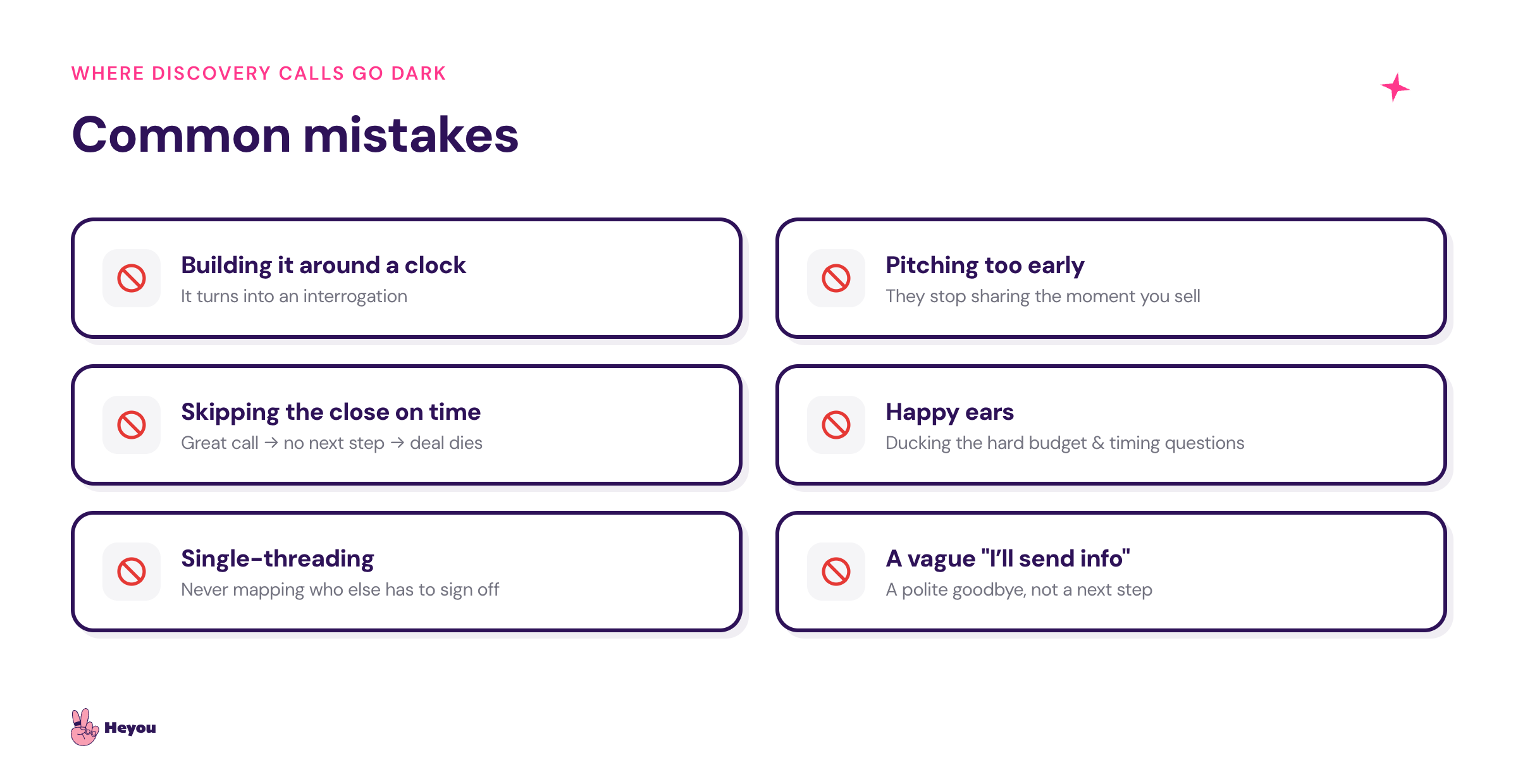
- Building it around a clock or a checklist. The fastest way to turn a conversation into an interrogation. If you are firing questions back to back so you can fill in the CRM, they can feel it.
- Pitching too early. The moment you start selling, the prospect stops sharing. You hear one problem, jump to "that is exactly what we do," and lose the next three things they were about to tell you.
- Skipping the close because you ran out of time. The call went long, you bonded, and you hung up with no next step. It felt like a win. It was a deal quietly starting to die.
- Happy ears. Hearing what you want to hear and skipping the uncomfortable questions about budget, timing, and who else decides.
- Single-threading. Talking only to your champion and never mapping who else signs off. A great call with a manager who, it turns out, needs three other people you never spoke to.
- Talking more than they do. If you are talking more than the prospect, it is not discovery, it is a monologue.
- A vague next step. "I'll send some info" is a polite goodbye, not a next step.
Discovery is not a stage you get through. It is a skill you keep sharpening, and it is the one that survives everything else changing around it.
Part of Selling skills, Heyou's guide to getting genuinely better at selling. More guides in this cluster are on the way.
← Back to the Selling Skills guide
How long should a discovery call be?
There is no fixed length. A good discovery call ends when you both understand whether there is a reason to keep talking, not when a timer runs out. Build it around a clock and it starts to feel like an interrogation. A useful shape is roughly 5 to 10 minutes to connect, 15 to 40 to go deep, and a protected 5 to 10 at the end to close.
What is the difference between a discovery call and a demo?
A discovery call is about learning their world: their situation, their problem, and whether you can genuinely help. A demo shows how something fits. If you demo before you have done discovery, you are guessing what matters to them, and it shows.
What is a compelling event in sales?
A compelling event is a time-sensitive, external pressure or deadline that forces a prospect to act by a specific date, such as a contract renewal, a regulatory deadline, or a board commitment. Without a real compelling event, deals tend to stall in the pipeline indefinitely, no matter how much the prospect likes you.
Is BANT still useful for discovery?
Yes, as a mental checklist of what to understand: Budget, Authority, Need, and Timeline. It stops being useful the moment you ask it like a form. Learn those four things through the conversation, not by reading them out.
How do you end a discovery call?
Reserve the last 5 to 10 minutes to summarize what you heard, confirm you got it right, and agree one specific, time-bound next step. Never end on 'let me know if you have questions.' That hands the prospect control, and the deal stalls.