Table of contents
Gartner expects AI agents to outnumber sellers 10 to 1 by 2028. Read that as a buyer for a second. For every salesperson trying to reach you, there will be 10 tireless agents researching you, writing you a personalized opener, and following up on Tuesday, and then again on Monday, "just bumping this to the top of your inbox."
Gartner also expects fewer than 40% of sellers to say those agents made them more productive. That makes sense. When reaching someone costs you nothing, it costs your competitors nothing too, and the advantage goes where every free thing eventually goes.
The shovel sellers say the mine is down to 2.1%
You can already see it in the inbox. One 2026 benchmark puts the median cold email reply rate at 2.1%, down from 4.7% in 2022. That figure was published by a company that sells cold email tools. If the people selling the shovels admit the mine is down to 2.1%, I would love to see the real number.
Buyers did not wait for us to figure it out. The 2026 6sense study of 4,611 B2B buyers found that 82% end up choosing the vendor they already favored before they ever spoke to a seller. Most of the deal is decided in a room we are not invited to, long before anyone books a demo.
Who is in that room when you're not?
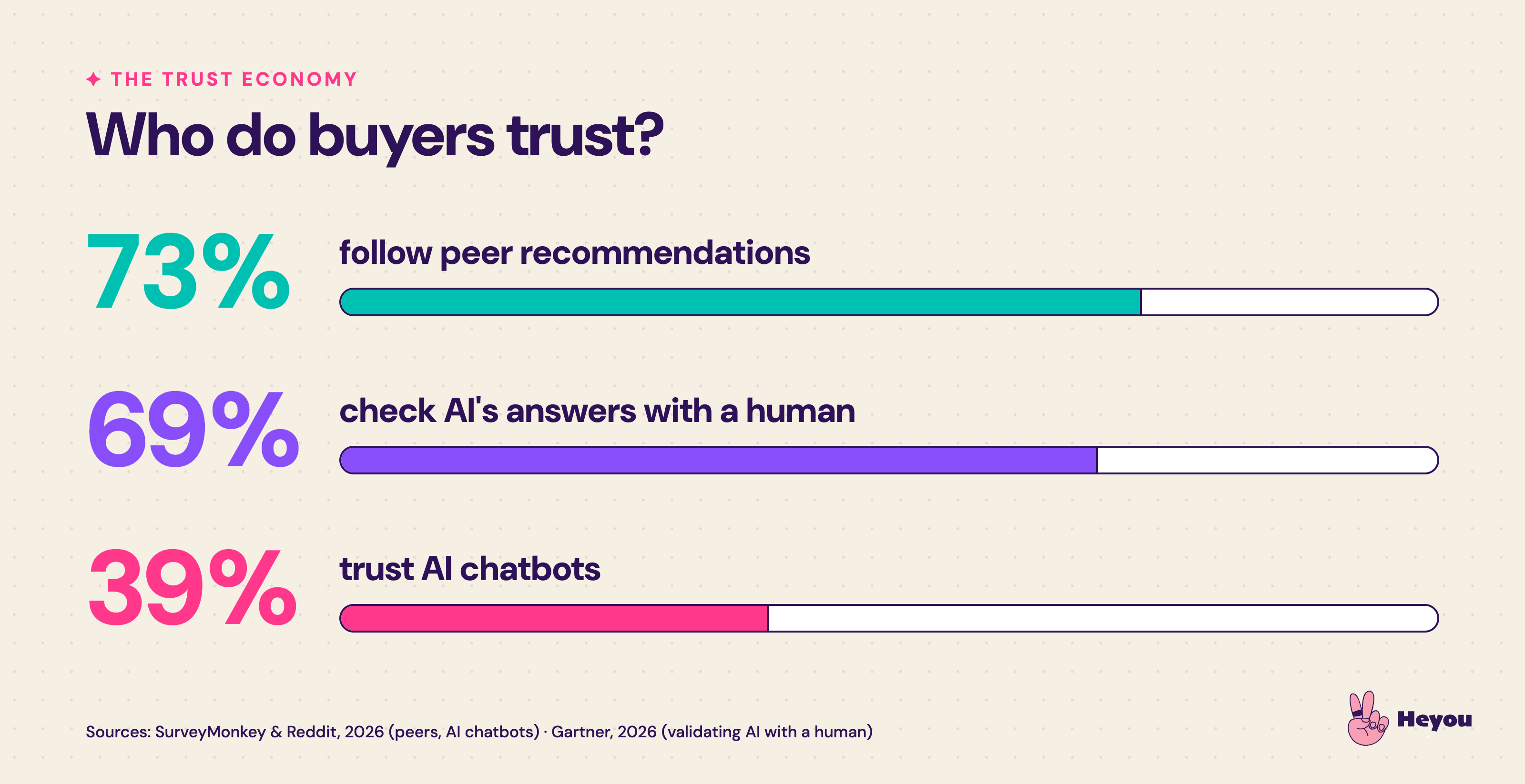
People. Look at who buyers say they trust this year:
- 73% of business decision-makers trust recommendations from peers, more than vendor websites, search engines or review sites (SurveyMonkey and Reddit, 2026).
- 69% of buyers still turn to a human to check what AI told them (Gartner, 2026).
- 39% trust AI chatbots, according to the same SurveyMonkey and Reddit study.
I would treat even that 39% as temporary. These assistants are built by companies that need to make money. Imagine trusting the assistant that helps you shortlist vendors, and then one morning it starts running ads. A business model can reprice trust in a product overnight.
Trust in a person who has your back does not go on sale.
What if your funnel is counting the wrong thing?
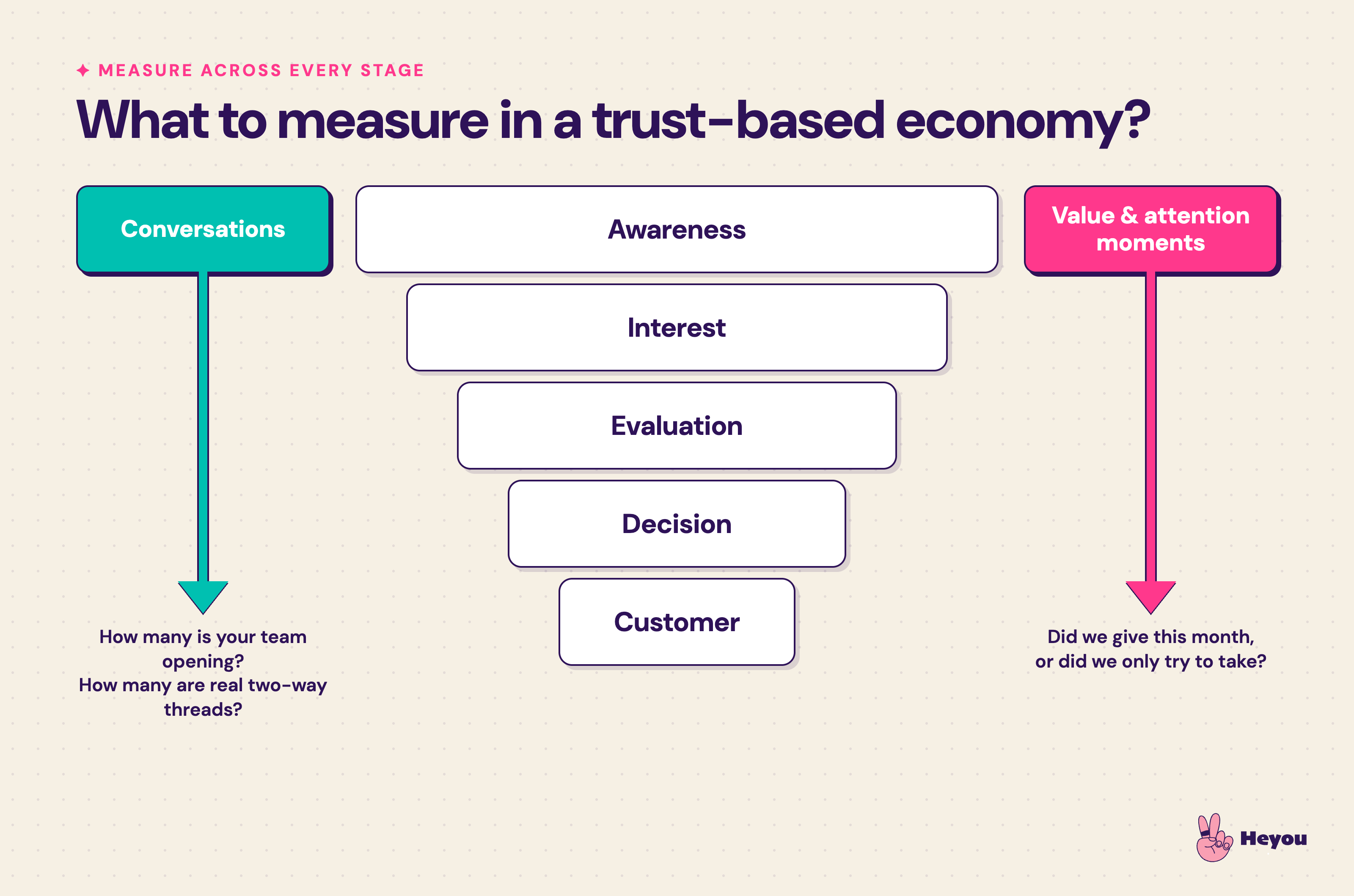
If people decide, the question your funnel has to answer changes. How many people would speak up for you when you are not in the room? You cannot measure that directly, but you can measure the 2 things that produce it, at every stage of the funnel:
- Conversations. Trust gets built in real two-way conversations, and we spent years counting sequence steps instead because they were easier to count. The metric: how many conversations is your team opening, and how many are real threads with real two-way flow?
- Value and attention moments. Someone you care about just raised a round, changed jobs, hired a team or published something they are proud of. Showing up with something useful right then is welcome, and the same message 3 weeks later is noise. The same goes for your customers when there is no renewal on the calendar, your community in a week when you have nothing to sell them, and your own employees, each of whom brings years of relationships into your company. The metric: did we give this month, or did we only try to take?
When we ran messaging workshops with sales leaders this year, price was not what held them back. Proof was. Every single person in the room asked for a named customer, a real result, or someone they trust saying it works. Buyers want a person to vouch for you, so build your funnel to produce those people.
Outbound gets a budget. Intros get 2 emoji reactions.
Most revenue leaders I talk to agree that relationships close their best deals. Very few run them as a channel. Outbound gets a budget, a headcount, a dashboard and a weekly review. Intros and referrals get a Slack message that starts with "does anyone know someone at..." and 2 emoji reactions.
A relationship-based pipeline deserves what every other channel you invest in gets:
- an owner,
- a target list,
- a weekly rhythm,
- and a number you review every week.
It is not expensive. It does require attention, which happens to be the thing most revenue teams spend everywhere else.
In a trust economy, time has a meaning. Trust compounds, so a relationship you start investing in this quarter is worth far more in 2 years than one you start in 2 years. The early adopters get those years. Everyone else gets to buy more agents.
Let the agents watch, so you can show up
I built Heyou for a reason. The world is going to have a lot more AI, a lot more data and a lot more fakeness, and the one thing that keeps its value is the people you can trust. In a trust economy, you want to be able to tap into your real relationships, and then build more bridges from there.
Last week we launched Heyou Anywhere, which our customers can now use alongside their Heyou experience. With Heyou Anywhere you can simply query your company's real relationships and ask:
- Who can get me into this account?
- Who else should I know there beyond my champion?
- Who can the person I am meeting tomorrow open a door to?
- Should I reach out myself, or have a colleague do it?
The agents do the watching, and you do the part only a person can do, which is showing up. If you want the view from the builder's side, Alon wrote about why most of your network is fake.
So if 82% of buyers pick their favorite before anyone calls them, who is speaking for you in that room right now?