Table of contents
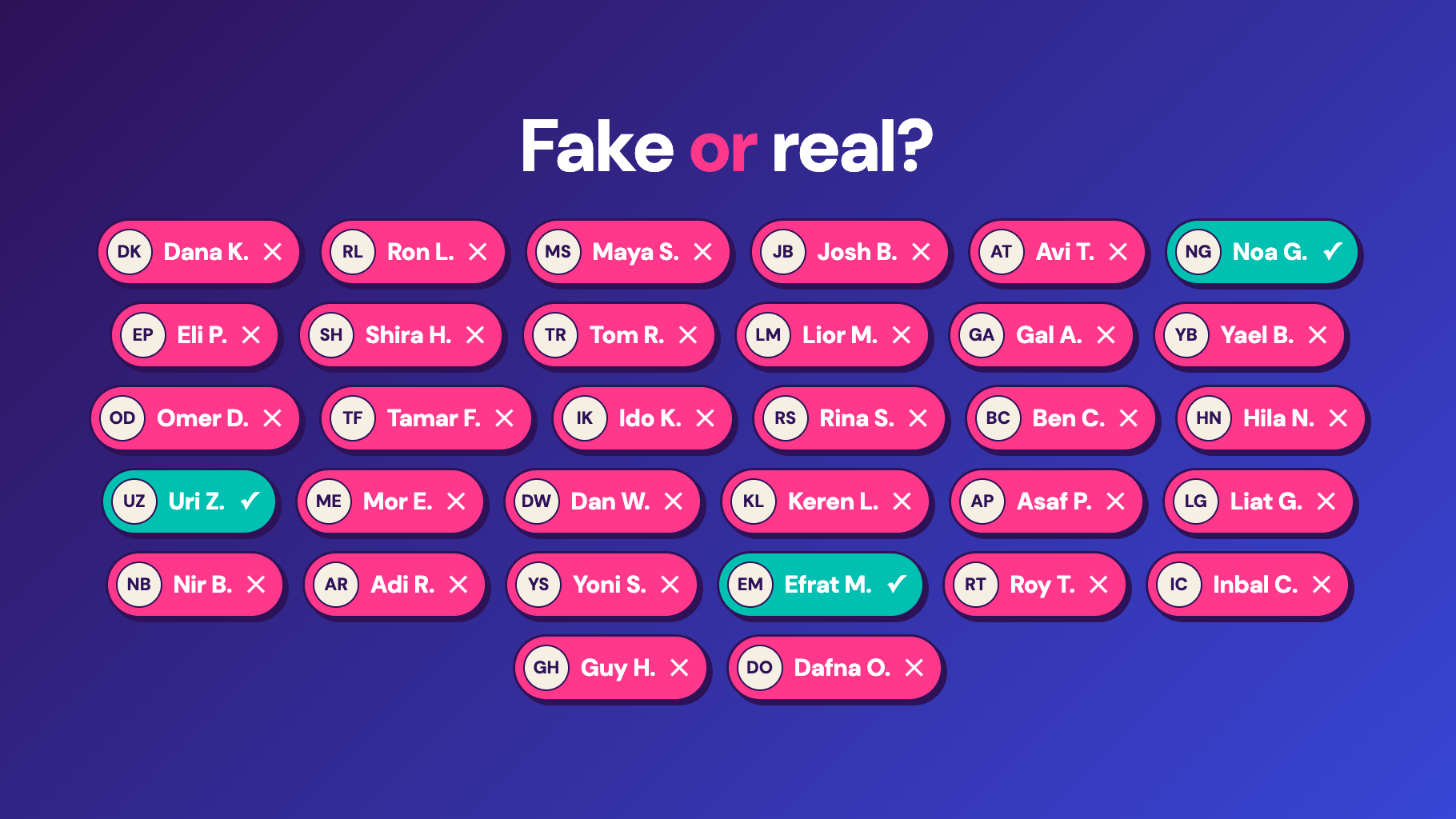
Name 10 people you know at the companies you sell to. Now cross out everyone who would not pick up if you called tomorrow. For most of us, the list gets short very fast.
That gap used to be a private embarrassment. It is quickly becoming the most important number in B2B sales.
When anyone can reach anyone, reaching means nothing
Contact data is a commodity now. Every tool has the same email address for the same buyer, and an AI agent ready to write to them. Gartner expects AI agents to outnumber sellers 10 to 1 by 2028.
Buyers have responded by leaning on people. The 2026 6sense study of 4,611 B2B buyers found that 82% end up choosing the vendor they already favored before they ever spoke to a seller. It is hard to form a favorite that early without listening to someone you trust.
So the scarce thing in sales is no longer a way to contact someone. It is a person who would make an effort for you.
20 million people, one uncomfortable finding
There is good science on this. In 2022, researchers from MIT, Harvard and Stanford published a study in Science based on experiments with more than 20 million members of a large professional network over 5 years. They wanted to know which relationships actually help people change jobs.
The answer was neither the closest friends nor the near-strangers. The relationships that moved people were in between: real enough to act, distant enough to open a world the person did not already see. Past roughly 10 mutual contacts, adding more stopped helping.
It is a study about jobs, so I will not stretch it further than it goes. The lesson I take from it is simpler. Knowing someone is a scale, and the line between 2 profiles tells you almost nothing about where on the scale you are.
I learned this the practical way, building Heyou. A pair who connected years ago and never spoke again looks exactly like a pair who sat a desk apart for 3 years.
On a list, they are identical. In real life, only one of them gets you the meeting.
3 questions that expose a fake relationship
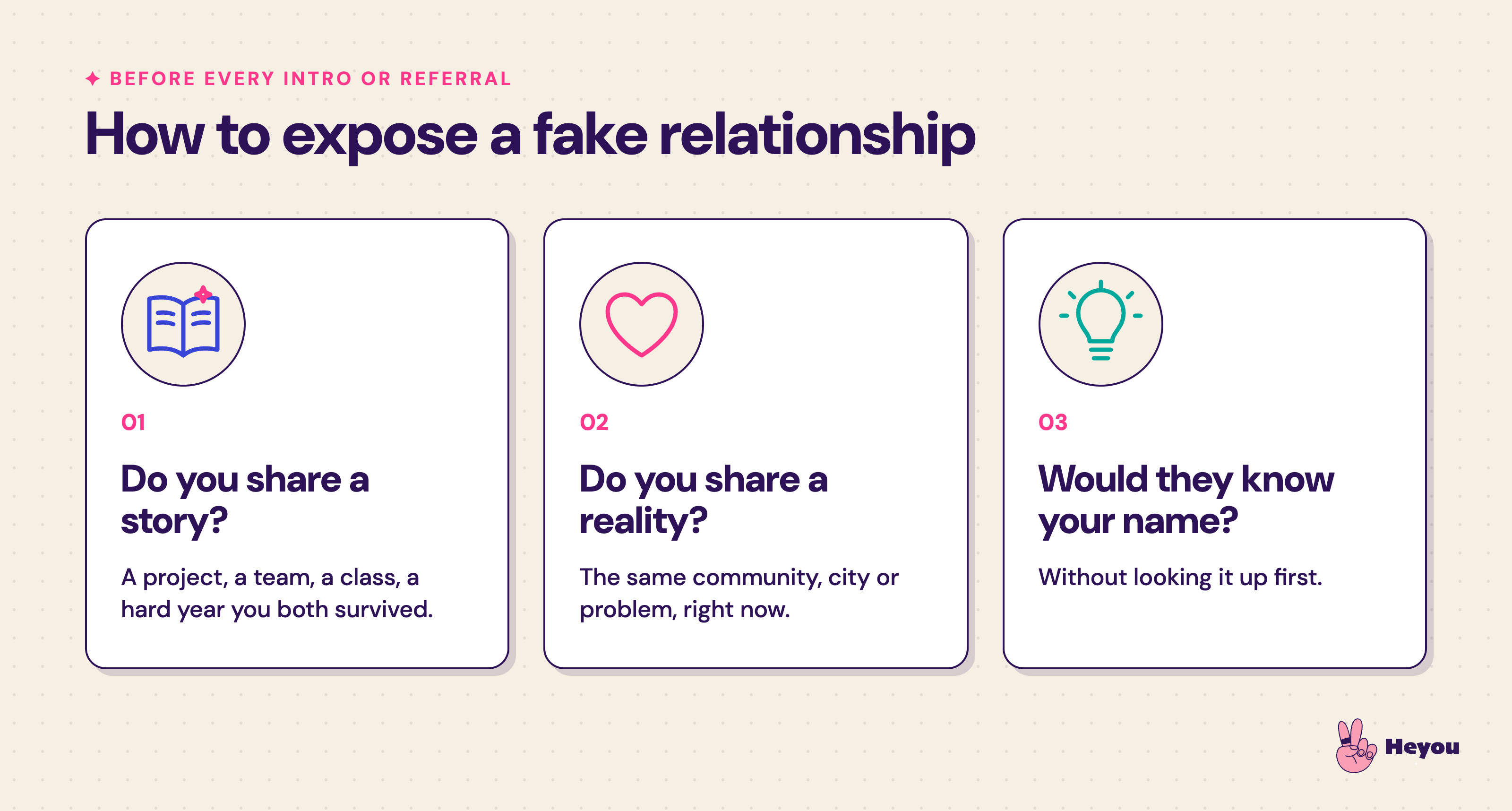
People are tied together by something they lived through, not by a line between 2 profiles. Before every intro or referral, ask yourself:
- Do you share a story? A project you shipped together, a hard year at the same company, a team, a class, a unit you served in.
- Do you share a reality right now? The same community, the same city, the same problem you are both working on this year.
- Would they recognize your name without looking it up? If they need to search for you, the story is not strong enough yet.
A person who passes all 3 is worth more than 50 who don't.
The same door is light one month and heavy the next
Strength is only half of it. The other half is timing: asking at the moment the relationship can carry the request. Right after you helped someone, the door is light. 3 years after your last conversation, it is heavy, no matter how good the relationship once was.
Sales leaders feel this too. When we surveyed B2B sales professionals, 55% said the thing they want most is to see the paths into an account the moment it is assigned to them, ahead of every other need we tested. Reps do not want more names. They want to know who would actually open the door, and when.
How to find the real paths into one account
Here is the process I would run for every account that matters, by hand, before asking anyone for anything:
- Map the people around the account, beyond the buyer. Their former colleagues, their investors, their customers, the communities they are active in. The buyer is rarely the best door to their own company.
- Search your whole company, not only the account owner. Your CEO's first manager, an engineer who studied with their VP, a customer who sits on their board, an investor who backed both of you. Most of the depth sits with people who would never think to raise their hand.
- Run the 3 questions on every path you find. Keep the ones with a shared story and a shared reality. Drop the rest without guilt.
- Check the timing. When did those 2 people last talk? Is there a moment right now, a new role, a launch, a raise, that makes reaching out natural?
- Give before you ask. Open with something useful to the person holding the path. The intro comes after.
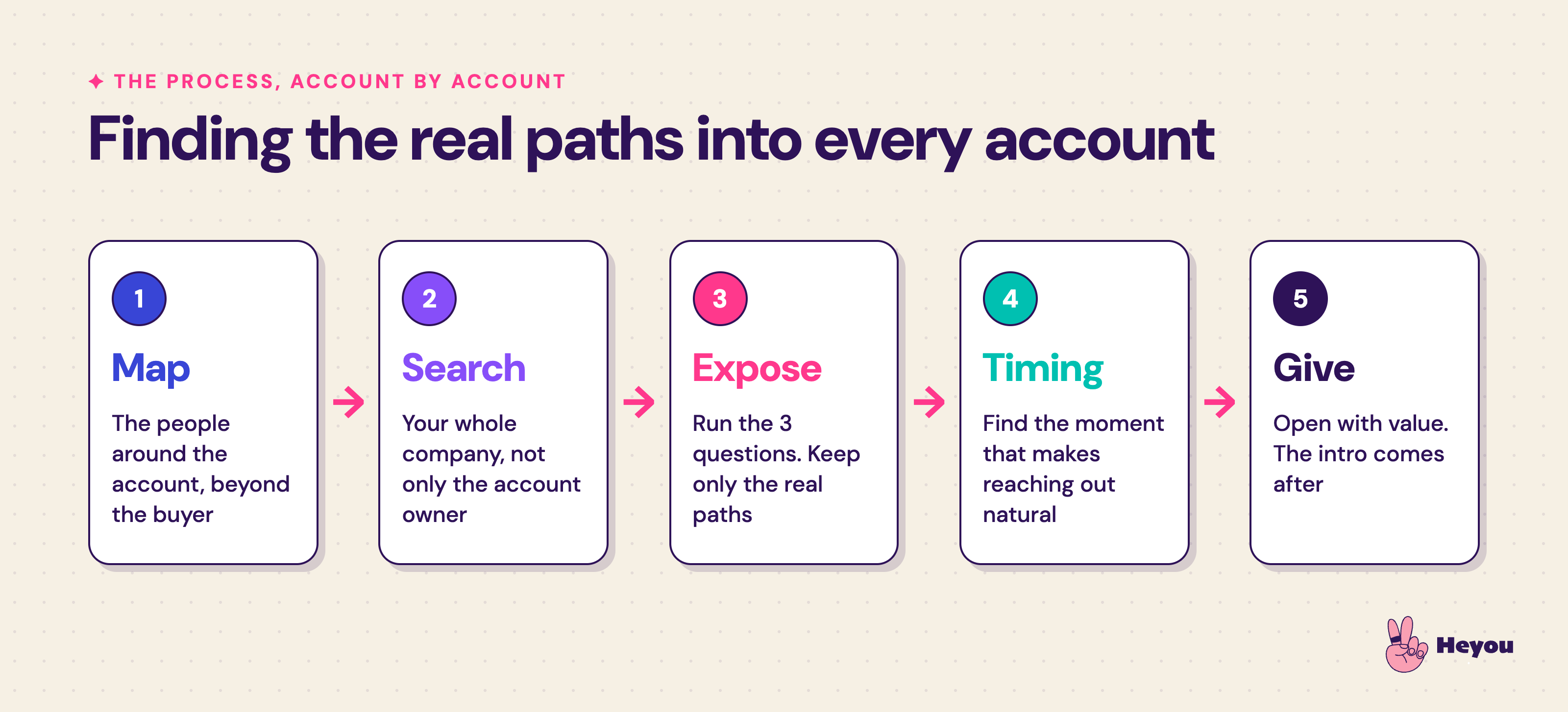
Done properly, that is a full afternoon for a single account.
Now do that for every account on your list
Answering those questions for one account over coffee is easy. Answering them for every account on your list, across your whole team, your customers and your investors, every week, is not something a human can keep up with.
That is the problem Heyou exists for. Hundreds of AI agents reason through your company's network and the people around your target accounts, work out who really knows who, and find the hidden paths in, including the ones nobody on your team could see on their own. Then they hand you the next move, so intros and referrals become a repeatable channel instead of a favor you ask for twice a year.
Last week we launched Heyou Anywhere, which our customers can now use alongside their Heyou experience. With Heyou Anywhere you can simply query your company's real relationships and ask:
- Who can get me into this account?
- Who else matters there beyond my champion?
- Who could the person I am meeting tomorrow open a door to?
- Should I reach out myself, or bring in a colleague?
Every answer comes with its reasoning, so you know why it is the right path before you use it. Sivan wrote about what this means for the whole funnel in AI made reaching buyers free, and now trust is the price.
The network you can actually count on is smaller than the one on your profile. The good news is that it can be grown, worked and kept alive, as long as you know who is really in it.